
The universe seems to follow the same methodology I use for cooking. Shove everything into a pot and hope for the best while setting it on fire. The exact descriptions of how the universe came to be has varied. Science is not static. Theories shift as we build on ideas, create new tools, and interpret data that we can use to map out the unfolding passage of time. With a few caveats. Firstly, the Big Bang was not necessarily the beginning, merely the beginning of the known universe. Secondly, it was not necessarily big nor a bang, but that’s the term the long-suffering physicists and we are stuck with. Welcome to the history of your home.
Time
The Universe is old. The Universe is big. Everyone you hate will die. Time will continue without us. This we can be certain of. Specifics, much like when trying to pinpoint both the speed and position of a particle is when the uncertainty kicks in. Our home is around 14 Billion years old, it’s still expanding borders hold an estimated 2 trillion galaxies, each containing over 100 billion stars. Are you fathoming yet? Brimming with understanding for the enormity of these figures? Comprehending perhaps? And that’s just a single universe.
We can understand the intrinsic link between energy, thermodynamics, particularly entropy, and time in theory, along with the sheer enormity and age of the universe, but full comprehension gets a bit weird. That doesn’t stop us from trying. Putting timestamps, and coordinates on everything. The beginning. The first of everything. The first stars. What happened? When? In exact and unequivocal order. The answer is we don’t know for sure. We’re pretty clever little monkeys with clever tools; visual aids for the very small, and the far away a long time ago, computer programs able to handle more data than we were ever evolved to deal with. That’s all science is. The best guess that we can come up with.
Now you’re feeling appropriately insignificant, let’s discuss time. The measurement of events. If nothing is in motion and matter is without form, then time cannot be measured. Before The Big Bang, it is theorised, what would become the universe was under too much pressure and too hot to have any measurement of entropy. Only after this energy was released from a singularity, time could start flowing. So now you’ve been caught in its current you’re stuck here. Let us meander down the passages of time.
Chapter One: The Early Universe

At this end of the timeline, it is easier to predict how long it took for something to form after the big bang rather than how long ago it was in relation to us. If the big bang shifts in time, so do all these events because they are largely based on how long the process took after the big bang. Welcome to the Primordial Era of the universe.
Big bang
13.8 Billion Years Ago
In the beginning, there was nothing. Which exploded. Our concept of nothing implies emptiness of a vacuum to be filled. The reality is, not even a vacuum existed until the not particularly big and probably not a bang happened. Whether it was a tiny pop, gentle leak, or resembled an agitated Pomeranian trapped in an empty fish bowl, we’ll never know, but these phrases don’t make headlines, so this sarky comment from a catty physicist who didn’t like the expanding universe theory is what we are stuck with. The Tiny Trumpeting happened around 13.4 to 14 billion years ago. A lot of energy was propelled out from a singularity. One point to physics for giving something a sensible name.
The big bang theory doesn’t explain where this energy came from and goes against established laws of physics, which is why quantum mechanics and quantum field theory exist. We can construct theories from the observable and measurable. Hazarding guesses about the age of our universe. With slightly different results depending on the method. Local markers like supernovae, and gravitational waves, give a younger estimate, while methods using cosmic microwave background, baryonic acoustic oscillation, and more recently in 2019 red giants, give estimates closer to 14 billion. For now, we’ll settle at 13.8.
Planck Epoch
The First 10-43 Seconds

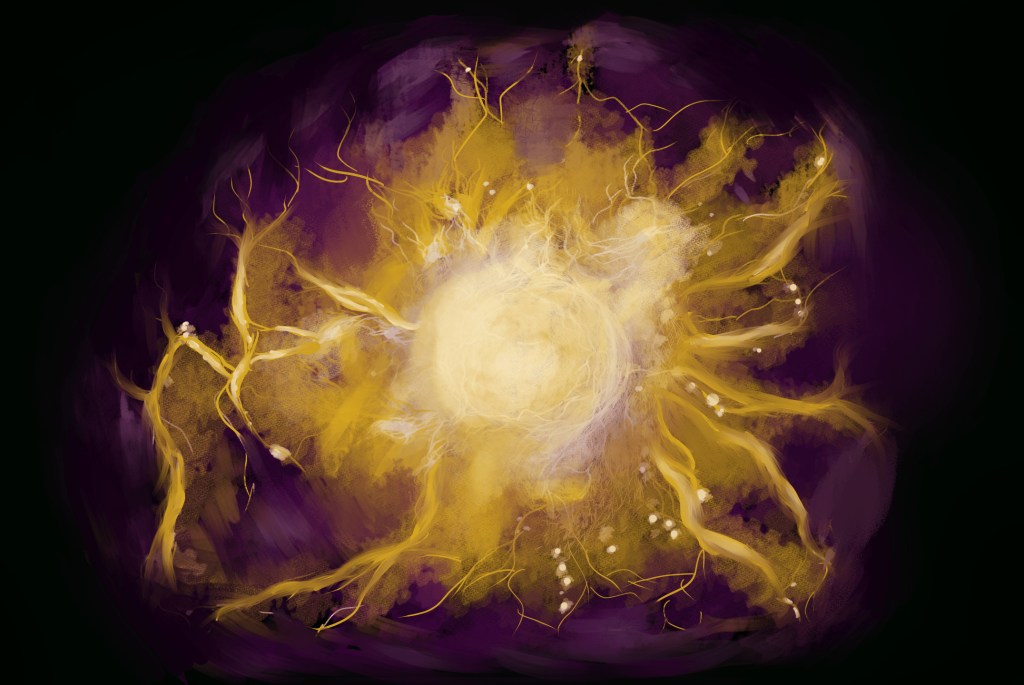
10-43or 0.0000000000000000000000000000000000000000001 seconds is 1 Planck Time, the closets physics can currently get to the beginning of time. It’s debatable how meaningful time was at this point and very little can be deduced about this period. General relativity proposes a gravitational singularity (although even that may break down due to quantum effects), we need particle physics, quantum mechanics and quantum field theory to even theorize what happened in the early universe. As it cools from 10 million billion degrees, plasma fills the tiny universe and starts to react to gravity and the nuclear strong and weak forces. One fundamental law is that energy doesn’t come from nothing, it changes. This is brought into question by black holes, but they don’t exist yet.
Grand Unification Theory Epoch
The First 10–43 Seconds
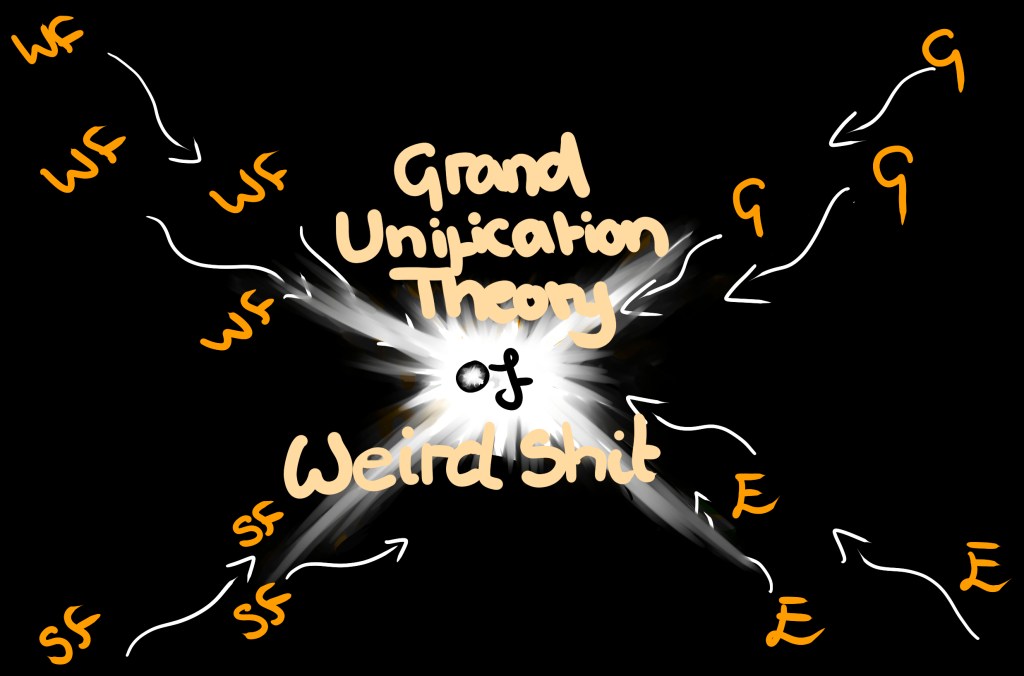
When nothing behaves as it should, and Einstein’s theory of relativity doesn’t work. The four fundamental forces; electromagnetism, (the interaction between charged particles) weak nuclear force, strong nuclear force (the two forces that holds atoms together) and gravity, all have the same strength, possibly even unifying into one fundamental force, held together by a perfect symmetry. Too symmetrical to last once entropy comes into effect. At this point, the temperature is over 1032 Kelvin. The force of gravity separates from the other fundamental forces (which remain unified), and the earliest elementary particles and antiparticles begin to form. This is all theoretical of course. Everything being compressed may have been the reason why forces and matter did not behave as they do now. As the temperature of this early universe cooled, expansion became possible.
It might be useful to note, that there is a pattern of unification and simple elegant equations for theories throughout physics, though none of the arbitrarily separated subsections of science are immune, there is a push to create a theory of everything, to distil nature into simple, elegant theories and equations to explain forces and processes. That doesn’t mean every theory ever created is terrible and should be ignored, but it is something to be aware of.
Electroweak Epoch
The First 10-36 Seconds
Inflation. Followed by reheating. The strong nuclear force separates from electromagnetism and the weak nuclear force. Particle interactions create large numbers of exotic particles, including W Boson, Z Bosons and Higgs Bosons. The resulting Higgs field slows particles down and confers mass on them, allowing a universe made entirely out of radiation to support things that have a small amount of mass. It was thought that electromagnetism was too weak to shape the universe, however with a new understanding of electromagnetic fields and fluid motion of plasma at extreme temperatures, it might be that this force was the first shaper of plasma, and the foundations that would later form galaxies. Just like with nuclear fusion, in these early days, magnetic fields are needed to trap energy in order for the plasma to cluster. A turbulent dynamo could form a magnetic field capable of holding the plasma in place and suppressing thermal diffusion. This isn’t just relevant to the very early universe, but also to astrophysicists and geophysicists as magnetic fields play a role in the formation of planetary and galactic systems. Turbulent dynamo theory explains how electromagnetism can influence the non-linear motion of fluids and may be able to help explain this early plasma, and later planetary and galactic formations. It may also be nonsense, but for what it’s worth I really want turbulent dynamo theory to be useful because it sounds amazing.
Inflation
First 10–36 to 10–32 Seconds
Triggered by the separation of the strong nuclear force and gravity, the universe rapidly and exponentially expands. known as cosmic inflation, the linear dimensions of the early universe increased in a fraction of a second by a factor of 1026. The elementary particles remaining from the Grand Unification Epoch (a hot, dense quark-gluon plasma, sometimes known as “quark soup”) becomes distributed very thinly across the comparatively tiny universe. The supercooling of the universe also brings the temperature down to 1022 kelvin.
Particle Era: Quarks and Stuff
10-12 seconds After The Big Bang
With the birth and eventual joining of these subatomic particles, quantum mechanical physics is born. Along with quantum indeterminacy. Observing a quantum object cannot necessarily determine a unique collection of values for its measurable properties. Basically, Quantum Indeterminacy is a fancy way of shrugging your shoulders about how subatomic particles move. The Uncertainty Principle is a quantum mechanics term for the limitations of how quantum objects’ potential position and velocity are measured. One of the few times mathematics fails when describing the universe. Quantum objects behave both as particles and waves, in order to find the precise velocity you need a larger wave packet, in order to find a more precise position you need a smaller wave package, leading to uncertainty in the aspect that is not being measured. The Particle Era describes the interactions between the 6 Quarks, 4 Gage Bozons, 6 Leptons, the formation of Hadrons, the Higgs Bozon and their respective anti-particles. don’t look at these things too hard unless you want to witness how broken the world-building of this reality is. My writer is a hack. This time period is made up of three epochs:

The Quark Epoch
10-12 Second After The Big Bang
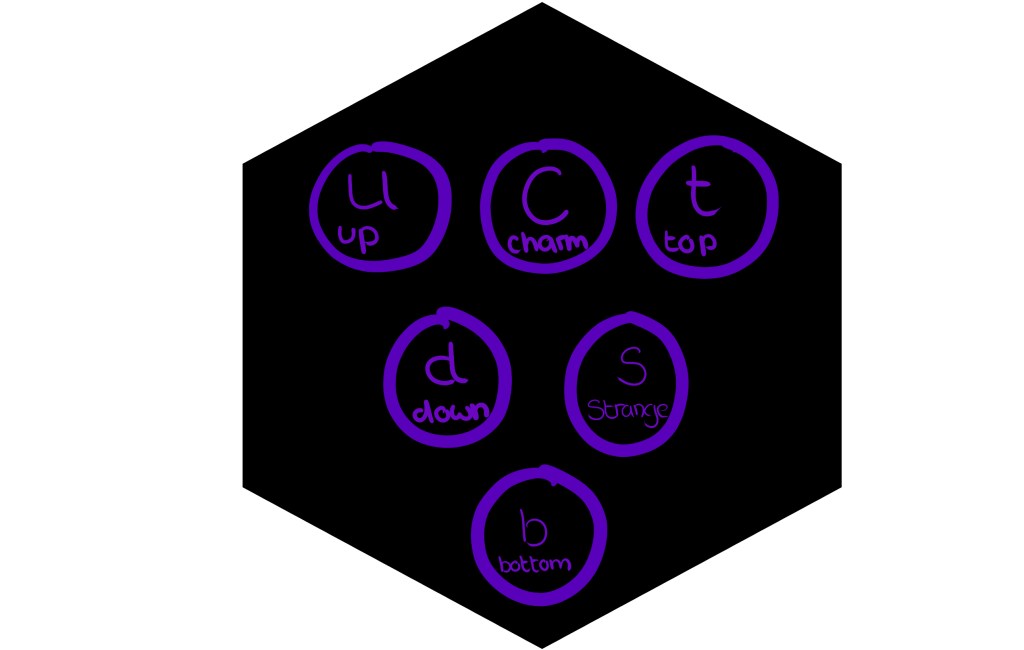
Where Quarks, electrons, and neutrinos form in large numbers as the universe cools to below 1015 Kelvin, and the four fundamental forces Gravitational, Electromagnetism, Strong force and Weak Force assume their present separate forms. Quarks and antiquarks annihilate each other upon contact, but in a process known as baryogenesis, a surplus of quarks (about one for every billion pairs) survives, which will ultimately combine to form matter.
The Hadron Epoch
10-6 Second After The Big Bang
The universe cools to a barmy trillion degrees celsius (1010 Kelvin if you don’t want to sound like an excited nine-year-old), cool enough to allow quarks to combine forming hadrons (protons and neutrons). Electrons collide with protons in the extreme conditions of the Hadron Epoch fusing to form neutrons and give off massless neutrinos, which continue to travel freely through space at or near to the speed of light. Some neutrons and neutrinos re-combine into new proton-electron pairs. The only rules governing all this apparently random combining and re-combining is the overall charge and energy being conserved.
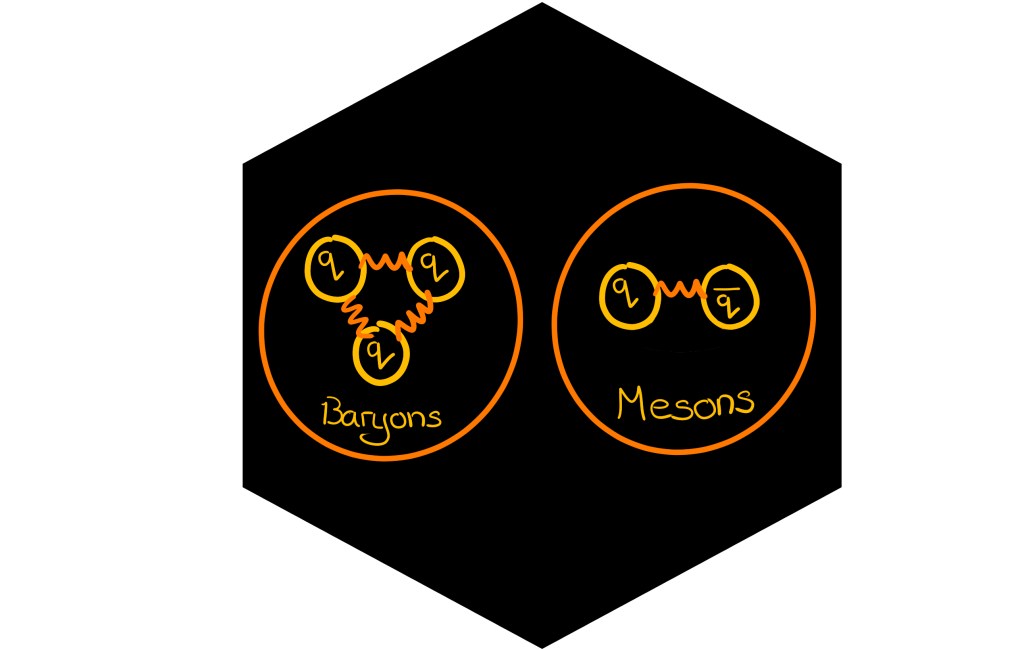
The lepton epoch
1 Second After The Big Bang
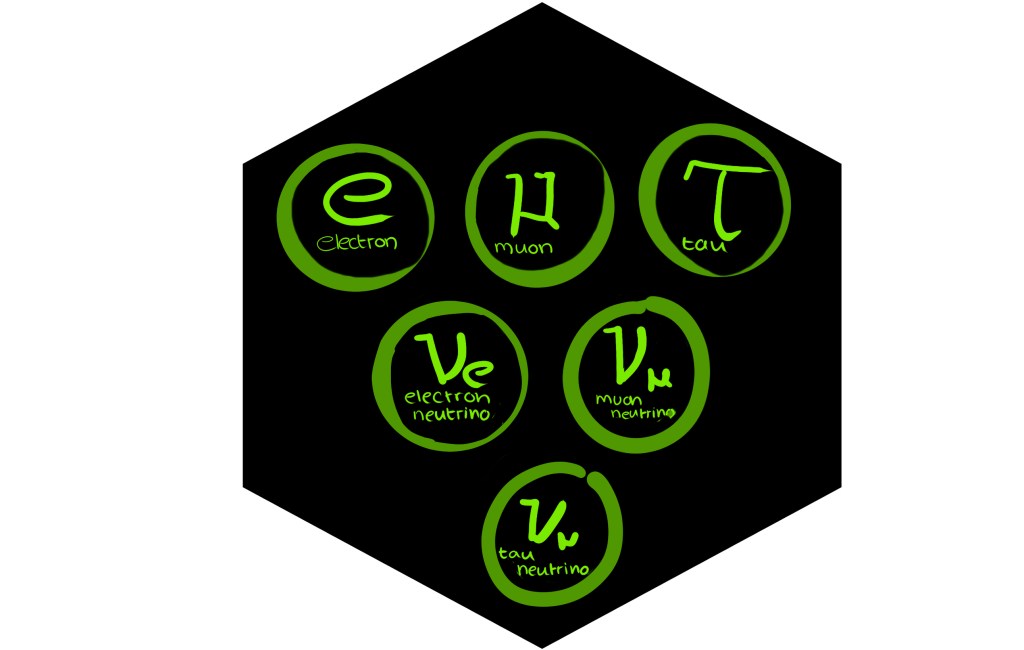
After the majority (but not all) of hadrons and anti-hadrons annihilate each other at the end of the Hadron Epoch, leptons (such as electrons) and anti-leptons (such as positrons) dominate the mass of the universe. As electrons and positrons collide, energy in the form of photons is freed. Colliding photons in turn create more electron-positron pairs. It’s a wild and chaotic time where particles are concerned.
The Radiation-Dominated Era
3 minutes to 240,000 Years After The Big Bang
Radiation is the only energy in the universe at this point. Prime setting for superheroes if matter existed to bring them form. Although this was a period of gradual cooling it was far from temperate, the universe was filled with plasma, a hot opaque soup of atomic nuclei and electrons. After most of the leptons and anti-leptons had annihilated each other at the end of the Lepton Epoch, the energy of the universe is dominated by photons, which continue to interact frequently with charged protons, electrons and nuclei.
Nucleosynthesis Era
3 to 20 Minutes After the Big Bang
The temperature of the universe falls to approximately a billion (109) kelvin, allowing for atomic nuclei to form. Protons and neutrons combine through nuclear fusion, forming the nuclei of simple elements like hydrogen, helium and lithium. After about 20 minutes, the temperature and density of the universe has fallen sufficiently (3’000 kelvin) where nuclear fusion cannot continue. At this time Lithium was the heaviest element that could form. Approximately 75% of baryonic matter is hydrogen, 25% helium and trace amounts of lithium. This primordial mix of elements is what created the first generation of stars.

The Matter Dominated Era
If you want to be fancy you can call this stuff baryonic matter, the smart arse and slightly more descriptive way of saying ordinary matter. Made up of protons, neutrons, and electrons, anything that interacts with light by producing, absorbing, or reflecting is baryonic matter. The fundamentals of what makes up our observable reality have formed. The energy and atoms channel in different ways, changing their states from the original plasma of the big bang to more disordered constructs, getting further and further removed from that original plasma as time progresses. The laws of physics dictate that even out of chaos, particles can find order again, order that we can identify as gasses or solids, organisms or metals, electricity or liquids, a process that has already started by the time matter dominated this small universe, but is far from over and only getting more complex and intricate. All these theoretical things that humanity can never see, but we can modal and imagine, unravelling the mechanics of our universe.
Atomic Epoch begins
50’000 Years After The Big Bang
The first epoch of the atomic era. The expansion of the universe decelerates, and the temperature has cooled to 3’000 Kelvin, allowing subatomic particles to start interacting with each other. Chemistry happens when one ordinary atom collides or interacts with another. Or several. The first of these reactions creates molecules, small tightly bound clusters of atoms. It is the electrons of these atoms that interact with each other not the nuclei, other than in the centre of a stellar mass, hence the name nuclear fusion.
Recombination Era & The First Elements
380’000 Years After The Big Bang
Anytime around 240’000 to 400’000 years after the big bang, depending where you get your information from, because some areas of science are about as consistent as a bag of ferrets, due to being hard to research. The recombination era was part of the atomic epoch. This era’s density continues to fall. Ionized hydrogen and helium atoms capture electrons (known as recombination), thus neutralizing their electric charge. Decoupling them and making a neutral universe. With Ions and Electrons recombine into neutral hydrogen and helium, and electrons bound to atoms. The universe finally becomes transparent to light, making this the earliest epoch observable today. It also releases photons into the universe which have been interacting with electrons and protons in an opaque photon-baryon fluid (known as “decoupling”), and these photons (the same ones we see in today’s cosmic background radiation) can now travel freely. All this light is what we know as the cosmic microwave background.

Cosmic Dark ages
400,000 After The Big Bang

Spanning across 400,000 to 1 Billion years after the big bang, after the formation of the first atoms, before the first stars, there was the Dark Cosmic Age. It’s hard to put any dates on this time period because the reason for its name pertains to the issues reading the redshift absorption and spin signals. Even at the beginning photons exist, but the universe is quite literately dark with very low energy levels across huge time spans. Meaning it’s difficult to gauge the age and little of note can be recorded.
The universe is dominated by mysterious “dark matter”. Your pet theoretical physicist theory of what makes up dark matter is usually WIMPs, weakly interacting massive particles, or MACHOs, massive compact halo object. That’s one scholastic point for the commitment to a pun. You might even get one or two talking about the most adorable teeny tiny primordial black holes. Our understanding of gravity likely needs an update, so how much of the observable effects of dark matter and dark energy (the theoretical force that drives inflation) are simply down to this, and how much is due to whatever dark matter ends up being we can’t say just yet. If you want to be a contrarian MOND, Modified Newtonian Dynamics is an interesting place to start.
With no stars to give off light, observable activity in the universe has trailed off dramatically. As the re-ionisation events progress, we can start to record events and theories again. In 2021 a paper was released that may give us a more accurate time period of when the first stars formed, 680 million years after the big bang, bringing the cosmic dark ages to an end, but it’s difficult to be definitive.
This section of the timeline is a bag of squirrels, because of the nature of the cosmic dark age and the patchy evidence. It is fiendishly difficult to determine when these aspects of universe evolution happened. As it is, we can theorise what triggered various events such as re-ionization and therefore what happened first, but putting a time stamp on these events is currently very difficult. Astrophysicists also tend not to differentiate these far-back times in terms of years but rather the redshift markers (z=Value) which is what you’ll find when you read astrophysics papers.
First Gen Stars
150 Million Years After The Big Bang
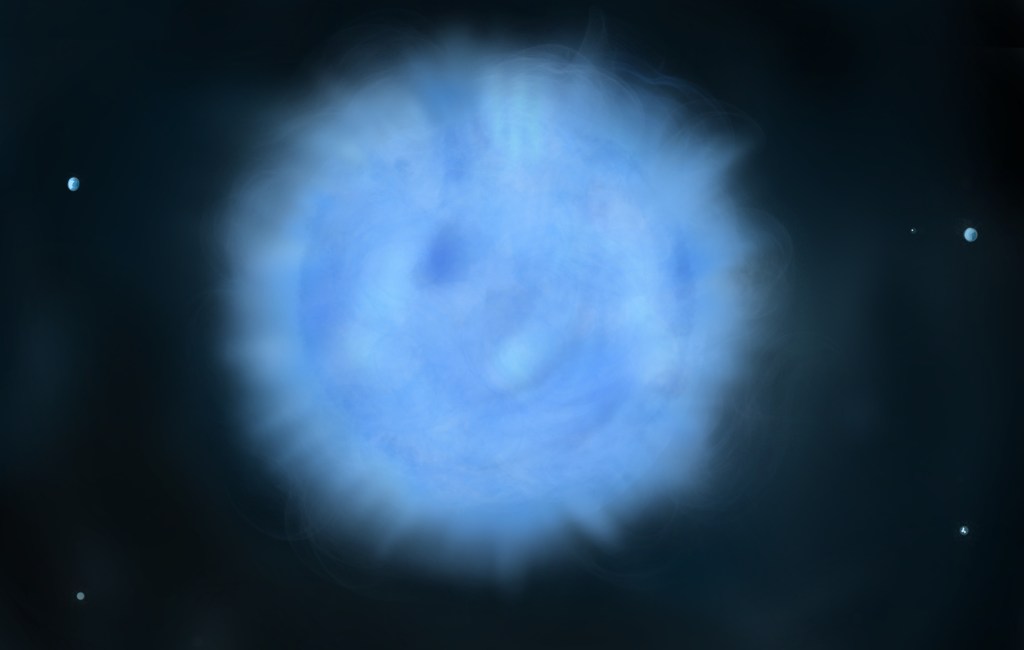
Hydrogen molecules form unstable bonds with each other, making H2, this extra electron is what makes helium. The unstable situation and collision of molecules lead to star formation. The first stars were huge short-lived supermassive stars, a hundred or so times the mass of our Sun, known as “metal-free” stars or blue giants. They burned very, hot very fast. This ball of nuclear fusion can only expel energy for so long before it burns itself out and collapses under its own weight. These stars are formed of hydrogen and helium, the primordial mix of gas that made up the early universe. Eventually. With the formation of these stars our current Universal Era, the Stelliferous Era begins.
Re-ionization Epoch
380 Million to 1.4 Billion Years After The Big Bang
Marked as z~15 to z~6 this gives an estimate of how long the re-ionization period lasted. It’s unclear when, but after the dark age, it happened in two parts the first being the re-ionization of hydrogen. The second of Helium, estimated to occur later. When people refer to ionization it’s usually in regard to hydrogen. At some stage after the dark ages (it’s unclear when), the second of two major phase changes to hydrogen gas in the universe occurs, the first being the Recombination period. From this point on, most of the universe goes from being neutral back to being composed of ionized plasma. Re-ionisation likely started after the first stars and protogalaxies.
Hydrogen re-ionization
At first, when we refer to hydrogen, it’s neutral hydrogen, it lacks any charge, it has never been anything else, it has always been hydrogen fresh from the oven of the big bang. Hydrogen particles begin to clump together and collide causing these neutral particles to become charged, this is re-ionising. As more hydrogen atoms clump together and interact they start to react and nuclear fusion occurs causing the first stars. The stars start to emit radiation, re-ionising their surroundings. Because these stars are so big and emit so much energy it is easy to see makers when looking at redshift. When these stars die and collapse the first quasars form, we can use quasars to see when re-ionisation occurred due to the difference in the signals from redshift. Whether the quasars were responsible for re-ionising the universe is still unclear, but they likely played a role, especially with the re-ionisation of helium which occurs later in this epoch.
Helium Re-ionization
The first quasars form from gravitational collapse, and the intense radiation they emit re-ionises the surrounding universe. The recent evidence suggests that the re-ionization of the universe’s 2nd most common element came much later than that of hydrogen.
First Galaxies and Black holes
400 Million Years After The Big Bang
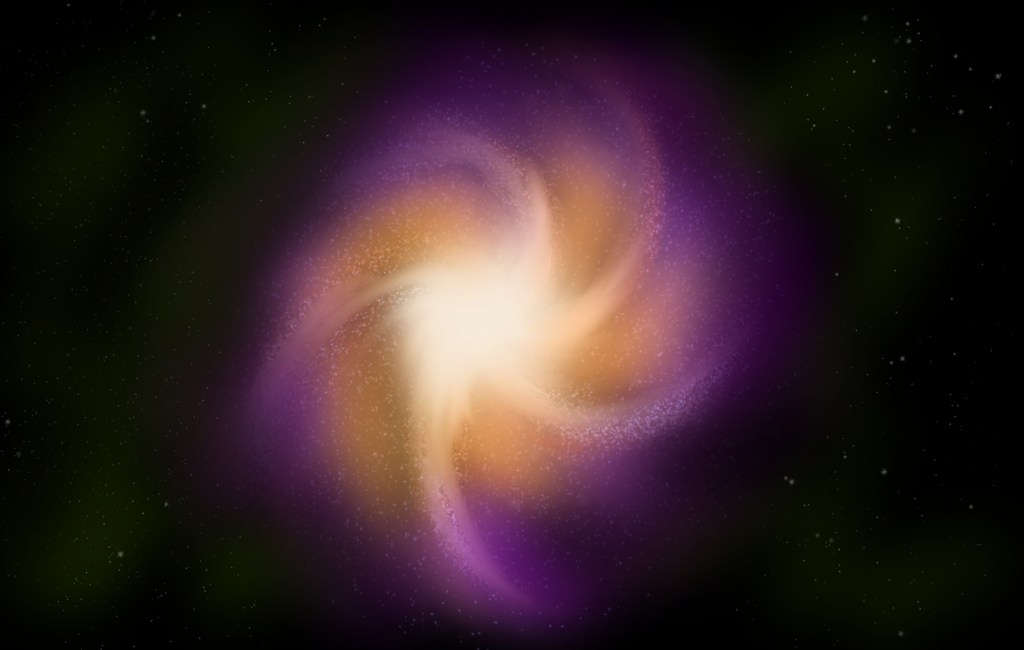
Evolving from protogalaxies, every current galaxy is centred around a supermassive black hole. Their formation is something of a mystery. One theory is when some of the first stars formed in denser clusters this led to a greater chance of black holes forming. Direct Collapse is another theory, based on theoretical primordial black holes, when matter clumps together at a greater density than 10% of the region around it, it collapses into a teeny tiny black hole. There has been some observational evidence for the direct collapse theory, but nowhere near enough to be definitive. Black holes maybe have formed first, drawing the stars into clusters due to gravity. So far the observational and modelling data, point towards stars forming first and gathering into clusters without a black hole in the centre of such a cluster. The James Webb Telescope may help us with a more concrete answer to this conundrum. What we do know is that when these first galaxies formed, some spiralled, others collided, leading to more and more complex molecules, minerals, and planets. Newer 2nd (pop II) and 3rd (pop I) generation stars have different compounds, even within one galaxy. One early Galaxies was the Milky Way, which is now your home, and centred around a supermassive black hole called Sagittarius A.
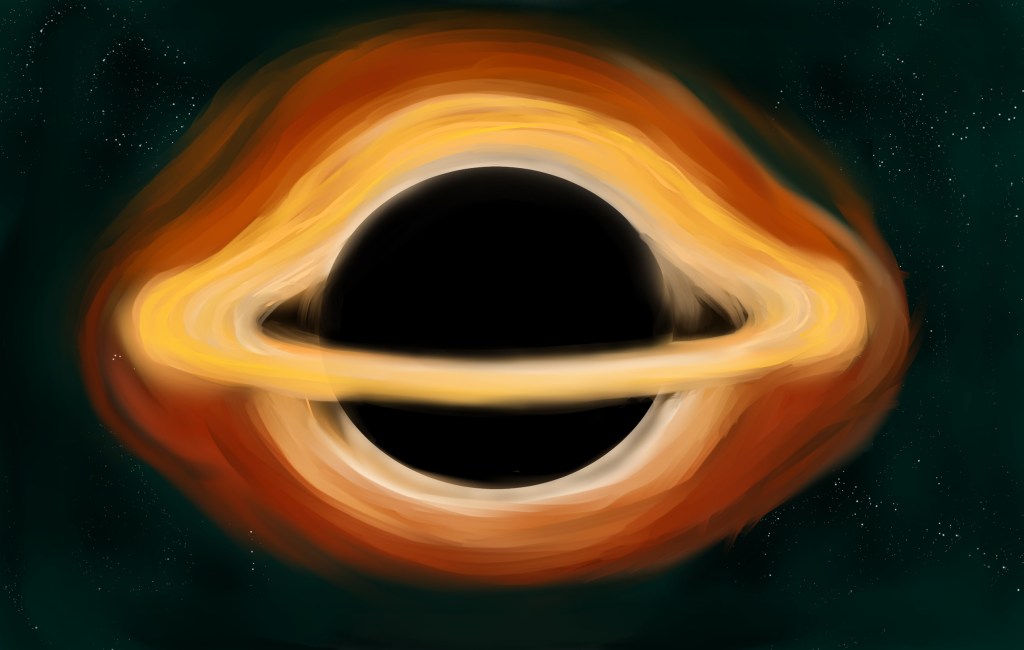
The first non-hypothetical black holes are the stellar mass black holes, forming when the core of a massive star collapses. The Black holes in the centre of galaxies are supermassive black holes, the type astrophysicists took a photo of, although it does not emit any light we can see their accretion disks, when matter settles into a circular motion that will eventually become part of the black hole’s mass. In order for this to happen the matter needs to lose energy so that it can slow down enough to go past the event horizon. Passing energy to other particles, this results in producing light which is why quasars (growing black holes) glow. As the black hole grows so does the galaxy. These two celestial objects appear to have co-evolved.
Physics, you get some scholastic points for some of logical names here and I take all of them away for calling black holes, black holes. Because they aren’t even holes! You lied to me and yourselves. I suppose you can have one point back for giving us Spigetification, which is my favourite word. Spigetification occurs when part of an object passes the event horizon because is has lost enough energy to fall into it, while the rest of the object continues to orbit the black hole, stretching the object and often ripping it apart in the process.
Second Gen Stars
300 Million to 1 Billion Years After The Big Bang
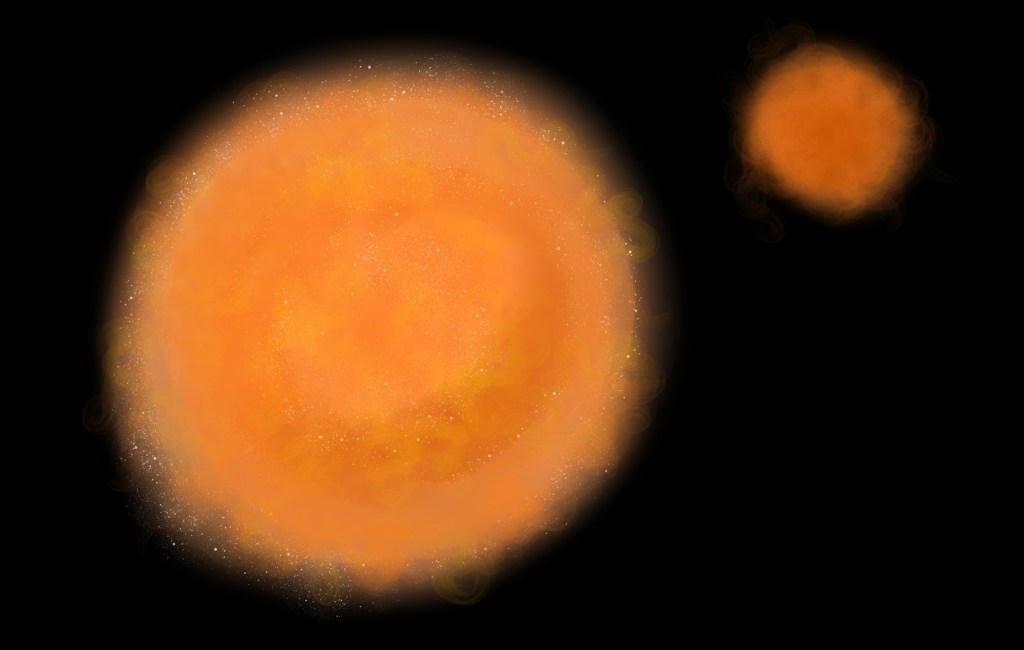
Physicists don’t care about anything smaller than a moon or larger than an atom, and anything with more mass than helium is a metal. Because science hates agreeing, convenience, and happiness. Try telling that to a biologist or chemist. Lose one scholastic point. This is also why 2nd gen stars are known as metallic stars because they comprise of more elements than just hydrogen, helium and minuscule traces of lithium. These stars will then collapse and explode out into nebulas, scattering dust and gasses throughout their galaxies. These 2nd and 3rd Generation stars begin to form from the resulting material of cosmic substrate of the now-dead blue giants. Within these stars, carbon, nitrogen, oxygen, iron, calcium, and magnesium can be found in varying amounts depending on the compounds present in the substrate. Larger stars burn out quickly and explode in massive supernova events. Large volumes of matter coalesce to form galaxies and gravitational attraction pulls galaxies towards each other to form clusters and superclusters.
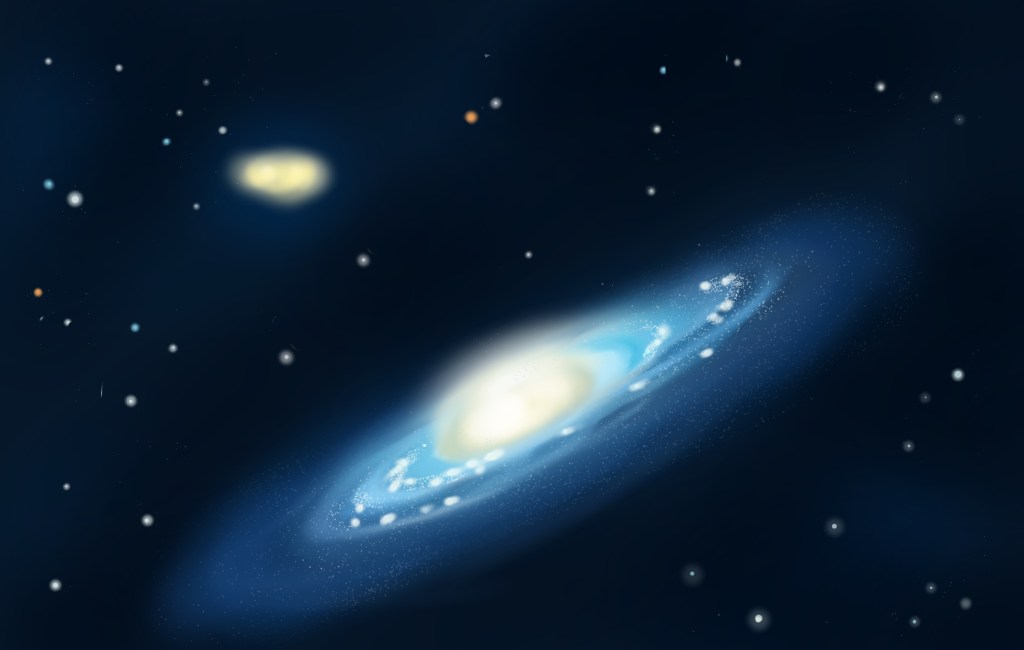
Our galaxy is closest to the Andromeda galaxy, both part of the Laniakea Supercluster, a huge collection of galaxies. Close to, but not a part of, the KBC void. A void holds less than 10% of the average density of the observable universe. These voids allow us to see the structure of the cosmic web and how gravity and dark energy interacts with universe expansion, caused by dark energy behaving in the opposite way of gravity.
The timespan of when these metallic stars formed varies greatly. It’s a hard time period to narrow down. We know they would have formed after the first generation started to die and overlapped with the birth of young galaxies and certainly cannot be older than the Big Bang. The James Webb and other future telescopes will likely give us more data to work with, giving us clues to the ages of stars that exist in the outer reaches of the observable universe. Stars like Methuselah (HD 140283), for instance, have huge error bars of uncertainty.
Dust And The Potato Radius
650 Million Years After The Big Bang
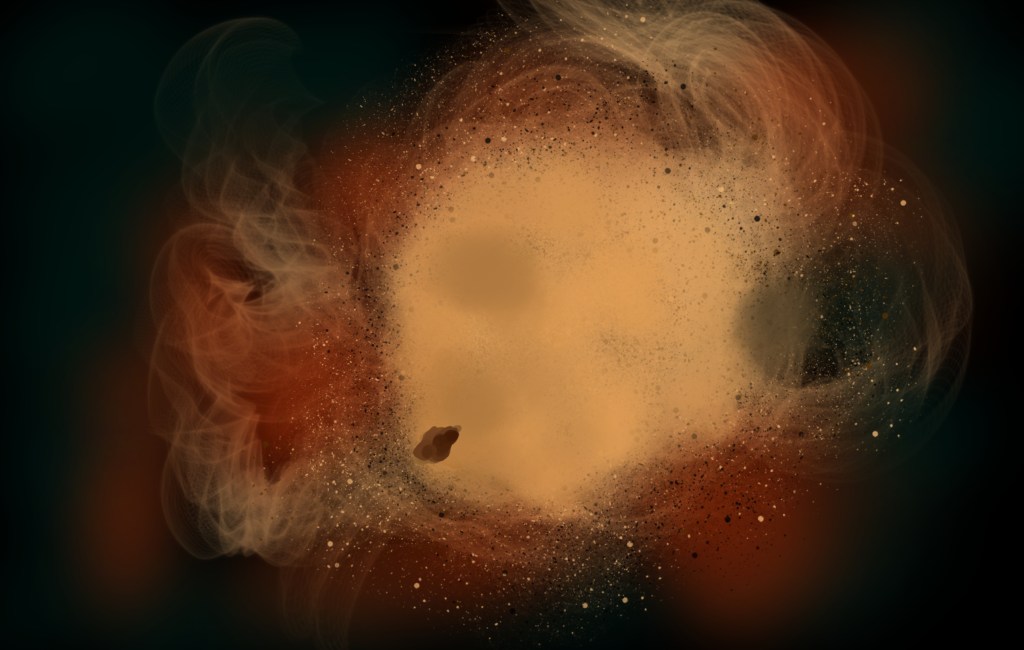
After the first molecules and supernova make yet more molecules, you have the minerals. Microscopic solid volumes of chemical perfection. Forming only when the densities of mineral-forming elements were high enough. This is where the cooling of the universe is important, the temperature needs to be at a low enough Kelvin for atoms to arrange themselves into crystalline structures. The resulting dust coalesces into the first planets, showing one of the fundamental laws of physics, the law of universal gravitation. The pressure of gravity is equal in all directions, meaning the most symmetrical shape is produced by the constant equal force of gravity. Celestial objects like moons and planets. When they reach a certain size (about a two-kilometre radius), they become as close to a globe as their orbit and matter allow. This is the potato radius, and I’m giving physics points for this name because I make the rules and this name makes me happy.
The Milky Way’s Disk Formed
11.7 Billion Years Ago
A thick disk of gas and dust showed an increase in iron content within stars at a time of high star formation within the disk. At the beginning, they had very little iron content and high hydrogen content, reflecting what we know and predict for the rest of the universe at this time. By 8 billion years ago, there is a high iron content in the disk’s stars.
For The Curious
Books
Bryson, B. (2016) A short history of nearly everything. Random House UK.
Smethurst, B. (2020) Space at the speed of light: The history of 14 billion years for people short on time. California: Ten Speed Press.
Papers
Arbey, A. and Mahmoudi, F., 2021. Dark matter and the early Universe: a review. Progress in Particle and Nuclear Physics, 119, p.103865. doi.org/10.1016/j.ppnp.2021.103865

Barkana, R. and Loeb, A. (2001) ‘In the beginning: The first sources of light and the reionization of the universe’, Physics Reports, 349(2), pp. 125–238. doi:10.1016/s0370-1573(01)00019-9.

Calosi, C. and Mariani, C. (2021) ‘Quantum indeterminacy’, Philosophy Compass, 16(4). doi:10.1111/phc3.12731.

Freedman, W.L. et al. (2019) “The Carnegie-Chicago Hubble Program. viii. an independent determination of the Hubble constant based on the tip of the red giant branch*,” The Astrophysical Journal, 882(1), p. 34. doi.10.3847/1538-4357/ab2f73.

Furlanetto, S.R. and Oh, S.P. (2008) “The history and morphology of helium reionization,” The Astrophysical Journal, 681(1), pp. 1–17. doi.10.1086/588546.

Lincoln, D. (2021) ‘Have astronomers found a star older than the Universe?’, The Physics Teacher, 59(3), pp. 154–158. doi:10.1119/10.0003653.

Miyatake, H., Harikane, Y., Ouchi, M., Ono, Y., Yamamoto, N., Nishizawa, A.J., Bahcall, N., Miyazaki, S. and Malagón, A.A.P., 2022. First identification of a CMB lensing signal produced by 1.5 million galaxies at z∼ 4: Constraints on matter density fluctuations at high redshift. Physical review letters,129(6), p.061301. doi.org/10.1103/PhysRevLett.129.061301

Morabito, L.K. et al. (2022) “Sub-arcsecond imaging with the International Lofar Telescope,” Astronomy & Astrophysics, 658. doi.10.1051/0004-6361/202140649.

Sweijen, F. et al. (2022) ‘High-resolution international LOFAR observations of 4C 43.15’, Astronomy & Astrophysics, 658. doi:10.1051/0004-6361/202039871.

Tobias, S.M. (2021) “The turbulent dynamo,” Journal of Fluid Mechanics, 912. doi.10.1017/jfm.2020.1055.

Vassallo, A. and Romano, D. (2023). The metaphysics of decoherence. Erkenntnis, 88(6), pp.2609-2631. doi.10.1007/s10670-021-00469-8
 Wonderfully Weird