

Welcome to the Aves phylum and their guide through this ecology-behavioural strategy we call monogamy. Trust me, you’re both Chordata. This will work. If there is anything that relationship advice from the internet has taught me, it’s that you can apply anything to any body. That, and having a spine makes certain aspects a lot easier. I present to you a Procellariiforme that wanders through everything, except its relationship. They’re not like the other 92% of pair-bonding birds, oh no. This is not only a summer-time fancy. Diomedea exulans is here for the long haul.
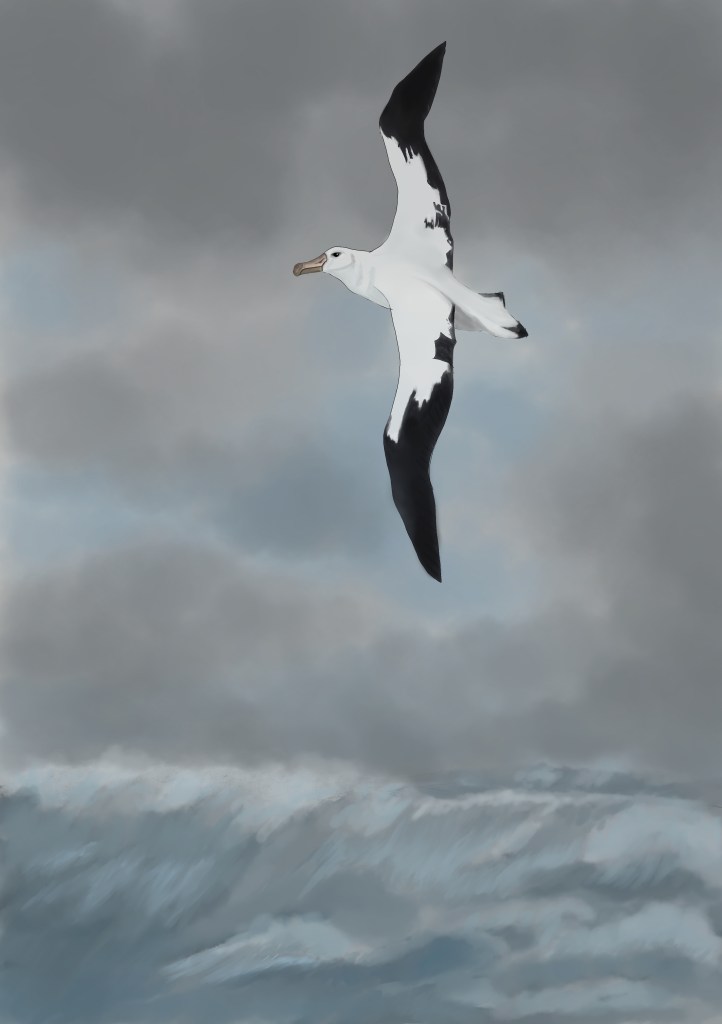
Assuming you’ve fledged without being scalped by mice, starved, or frozen to death, you’ll have roamed the seas and oceans, barely touching land for 7 to 11 years, before even trying to achieve the divine pleasure of finding a relationship worth your lifetime. Whether that life is the average mid 30s to 40s or the vague hope of 50, is one thing. How the hell you stay together when you barely see each other, is another.
So you’ve bowed, pointed and yapped your way into a relationship, (precopulatory selection methods may differ between species. I take no responsibility). You’ve even built a one-bedroom home together. You have found yourself the one. For the first year or three, you’ll likely meet up and do the whole sky calling, flagging thing, and lots of allopreening, because physical contact is important. Supposedly. I type this while the whole COVID-19 thing is happening… ya.
In any case, choose a partner while grounded, “beauty is even more likely to be in the eye of the beholder if the feet of the beholder are on something solid. At ten thousand feet up, the eye of the beholder tends to water.”
Terry Pratchett. Carpe Jungulum
The whole chick-rearing malarkey won’t be relevant for a while, even with the assumption the egg hatched on the first try, this isn’t always the case, lots of paired albatrosses find this part difficult in the beginning.
1st piece of advice Don’t die
If you die, all was for nothing. The whole point of a long-distance relationship is that you see each other again. And since albatrosses don’t have a religion, living becomes the only option. Starving to death is suboptimal. Being eaten becomes dissatisfying, and being caught in fine fishing nets will drag you down. Leaving your love to morn you for a year and a day. Before moving on and finding another partner, but the next one could be shit.
Your high trophic position may ensure your safety from most dangers, but best keep to the Pelagic take-aways. Avoiding Pinnipeds, Delphinids, or Chondrichthyes is always best. It might be fine but the consequences of it not being fine is a big ol’ pile of fly-the-fuck-away. The art of cost-benefit analysis says pick your battles. Speaking of cost-benefit analysis, keep up on your foraging. Systematic when staying close to land and random for the rest of the time seems to be the go-to strategies for the breeding year.
Reunions
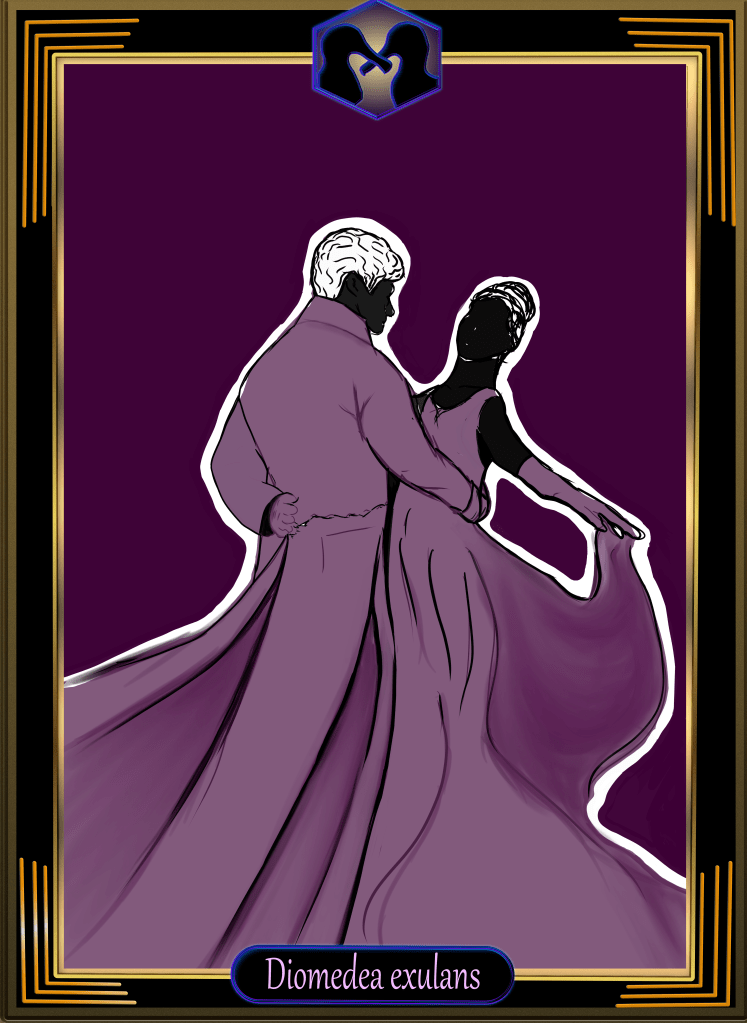
The month of intersexual interaction. Seeing each other after so long can be… tricky. What if you restyle your feathers (ill-advised but accidents happen) Your partner needs to recognise you and feel like nothing between you has changed. That means it’s back to the dancing like no-one but your partner is watching. Intensely. And very critically. This brought you together once, and so it will again after your sabbatical year. Once you have the affirmation that your partner is indeed your partner, and is still fit enough to dance and keep up with you, Albatrosses would recommend lot of allopreening followed by lots of sex. Until an egg is laid. Some things can’t be helped when you’re an albatross. Chicks have a habit of requiring all your time and energy.
Raising a feathery beachball
From incubation to the fledging you don’t even have to be there to see, You’ll spend about 356 days raising a creature that shares roughly 50% of your alleles, so don’t freak out if there are some differences. Keep a steady supply of fish and squid coming, preferably given to your loved ones via an oil solution. Then trade places! Because the little one said so.
Smoothies and oils aren’t a substitute for actual meals. Leaving the house is a requirement for sanity and health. Once your child has hatched and can regulate its own body temperature, the slacker, you can leave them completely alone. They’ll be fine. Probably. I’m 64% sure they’ll survive. The perils of parental investment for altricial offspring. You then both bring back food for the demanding little shit until it resembled a feathery beachball and can then leave it to develop into something that looks more like a functional, aerodynamically sound avian.
With child-rearing done, you’re no longer tethered to land… or each other. Just because you can’t live with them, doesn’t mean you can live without them. you’ll see each other again, having recovered emotionally and physically from caring for your only child. And so the dance starts over again. Just assume that the chick managed to fledge successfully, it’ll spend 7 to 11 years roaming the oceans, maybe even visiting the tip of Africa, just as you did. Albatrosses have the neuro simplistic, out of sight out of mind policy, when it comes to social grouping.
Keep it simple
Spoil your chick while it’s around, you don’t need a large family to be a happy little albatross. I say little, your wingspan is three metres.
No dying. Leave a year between children. Have loads of sex for a few days and then go back to sea. Co-parenting is key. Leave your child alone and often. Enjoy your lives together, and live as an ocean roaming hermit for the majority of it. Oh yeah, and have no friends.
Until next time Dear Reader. Have a nice day, and have a great life.
For the curious
Croxall, J. P., P. Rothery, S. P. C. Pickering, and P. A. Prince. "Reproductive Performance, Recruitment and Survival of Wandering Albatrosses Diomedea Exulans at Bird Island, South Georgia." Journal of Animal Ecology 59, no. 2 (1990): 775-96. Accessed June 22, 2020. doi:10.2307/4895.

Fay, R., Barbraud, C., Delord, K. and Weimerskirch, H. (2016) "Variation in the age of first reproduction: different strategies or individual quality?", Ecology, 97(7), pp. 1842-1851. doi: 10.1890/15-1485.1.

JOUVENTIN, P., CHARMANTIER, A., DUBOIS, M., JARNE, P. and BRIED, J.(2006) "Extra-pair paternity in the strongly monogamous Wandering Albatross Diomedea exulans has no apparent benefits for females", Ibis, 149(1), pp. 67-78. doi: 10.1111/j.1474-919x.2006.00597.x.

Lecomte, V. J., Sorci, G., Cornet, S., Jaeger, A., Faivre, B., Arnoux, E., Gaillard, M., Trouve, C., Besson, D., Chastel, O. and Weimerskirch, H. (2010) "Patterns of aging in the long-lived wandering albatross", Proceedings of the National Academy of Sciences, 107(14), pp. 6370-6375. doi: 10.1073/pnas.0911181107.

Pardo, D., Barbraud, C. and Weimerskirch, H. (2013) "Females better face senescence in the wandering albatross", Oecologia, 173(4), pp. 1283-1294. doi: 10.1007/s00442-013-2704-x.

Weimerskirch, H., Salamolard, M., Sarrazin, F. and Jouventin, P. (1993) "Foraging Strategy of Wandering Albatrosses Through The Breeding Season: A Study Using Satellite Telemetry", The Auk, 110(2), pp. 325-342.
 Wonderfully Weird
Leave a comment