
Allow me to introduce the supreme serpents, of the somewhat stereotypic, semi-aquatic squamata order from South America. A Reptilia of repose, Anacondas tend to stay in areas with easy access to water bodies and bodies of food. From the forest rivers to seasonally flooded savannas and inland wetlands. If it’s damp, it’s sufficient for our Boidae family. Green Anacondas are not alone in the Eunectes genus, although it’s the most recognisable, well-researched, and focus of our wander through Autodidactic Dramatics’s first reptile article. They are sometimes considered primitive; retaining heavier more ridged skulls, but age can hold wisdom, and many many rats. So allow me to present some advice for obtaining the most amount of food for the least amount of cost.
Witches are very keen on pickles, as a rule but the food they like best is free food. Yes, that’s the diet for your working witch: lots of food that someone else is paying for, and so much of it that there is enough to shove in your pockets for later.
Witches By Terry Pratchett
Caveats
The unorthodox method of turning into a snake may lead other bills to skyrocket. If you live in a temperate or cold climate with terrible insulation. In order to digest food effectively you need tropical humid heat (25 to 27ºC at 88% humidity) to keep your internal environment within its preferred parameters. Autodidactic Dramatics only solves one problem at a time. You’ll have to go to the Emperor Penguins for advice on how to stay warm.
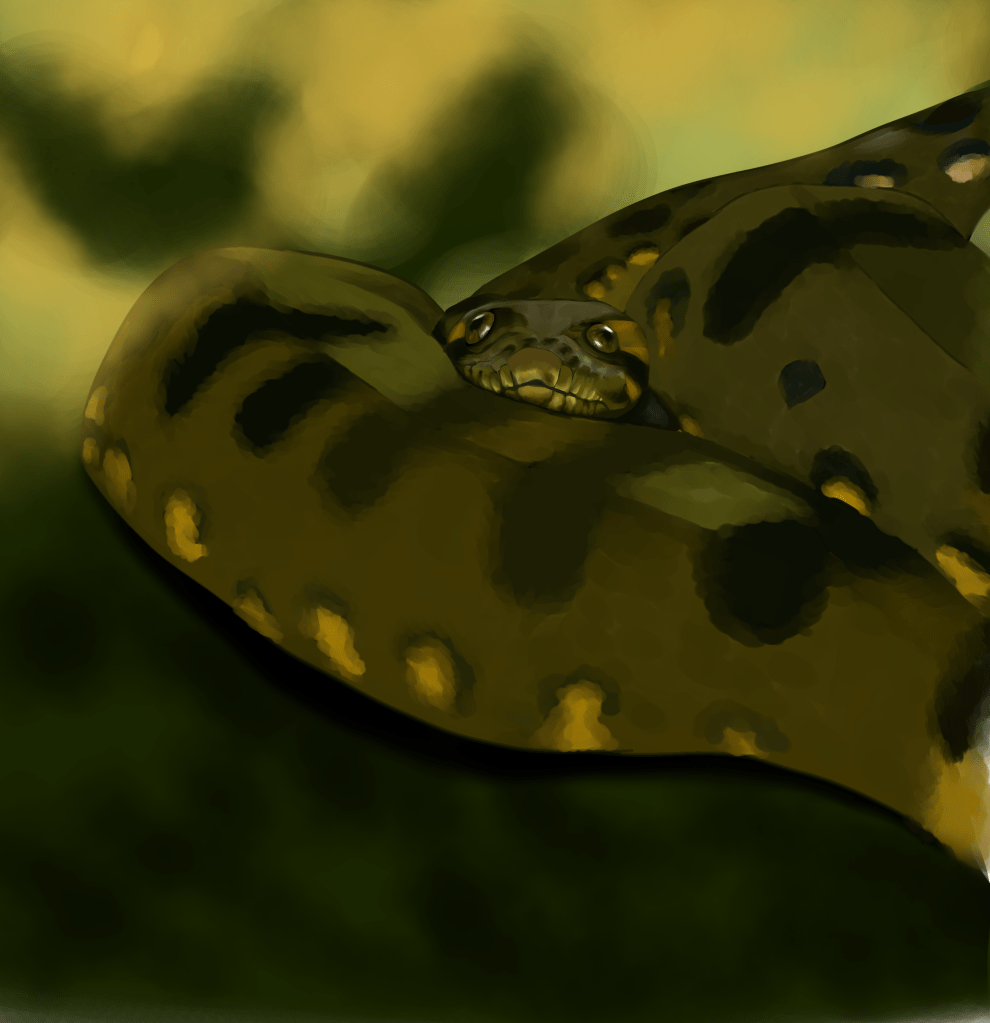
Anacondas are solitary and females have the ability to stave off fertilisation if they are not in a resource-sufficient environment, so if you are thinking of, or currently have young hominids, you may want to find some more mammalian-friendly model. Anacondas live an almost entirely aquatic existence, this means that their status as ‘heaviest snake’ in the world is accepted but hard to measure, and ‘longest snake’ is still a debated title with Reticulated Pythons (Malayopython reticulatus). This 7 to 8 meter bulk means they both require, and are capable of eating large prey, but their reptilian bodies are still cheaper to run than your mammalian one. They’ve also got a more efficient digestive system, so long as you keep to a strict diet of constrictable critters. With that, let’s investigate if this simple yet sophisticated serpentine body plan is right for you.
Food preferences
Being a clever little omnivorousness forager that can bulk cook as much veg, meat, and grain as you desire, refrigerate or freeze them in Tupperware, ensuring ready meals for days is not an option afforded to anacondas. They are not scavengers. They lack slow cookers, microwaves, and thumbs. You’ll have to disband with this luxurious idea of food being easy, quick, or even the job of someone else to obtain. Firstly as an anaconda, you don’t have a fixed address. Secondly, you’ll be an obligate carnivore of the recently deceased or defrosted; depending on whether you prefer the comfortable but dangerous great outdoors or the slightly to very cramped but convenient enclosures, with a home delivery service. The eternal quandary of country versus city life and probably about as much autonomy over which to choose.
Meat is expensive. If you’re going to be an obligate carnivore, you need all the help you can get even if that is 160 million-year-old advice from a serpent sub-order. So, like hunting the Olio app for free food, you must have a knowledge of where the most cost-effective areas to hunt are. There is a little cannibalism shown by adult anacondas, but I’d recommend staying away from this particular habit. If you’re in a position where cannibalism is your only option, saving money is probably at the bottom of your priority list.
Hunting
Concertina locomotion isn’t the most stealthy way of travel, but like many snakes, Anacondas are ambush predators. They’re constrictors. The standard strike and coil is the go-to method. Constricting doesn’t just work by preventing the prey from breathing, but by applying pressure to the thoracic cavity, which can cause circulatory arrest, stopping the prey’s heart. This pressure or force often breaks or dislocates the prey’s spine, paralysing them, if they are still alive.
How energetic your hunting habits are can vary. You have a choice; increase your energy expenditure to find prey, captive snakes that are habituated to regular feeding often become more active when they expect their delivery. This quasi-foraging behaviour usually stops after a few days due to the increased energy expenditure and the perceived risk of predation, leading us to your second choice; reduce energy expenditure by seeking cooler microhabitats and conserve energy. This will slow your metabolism. The mechanisms responsible for the starvation-induced hypo-metabolic responses among snakes remain generally unexplored, so it’s up to you to explore them.
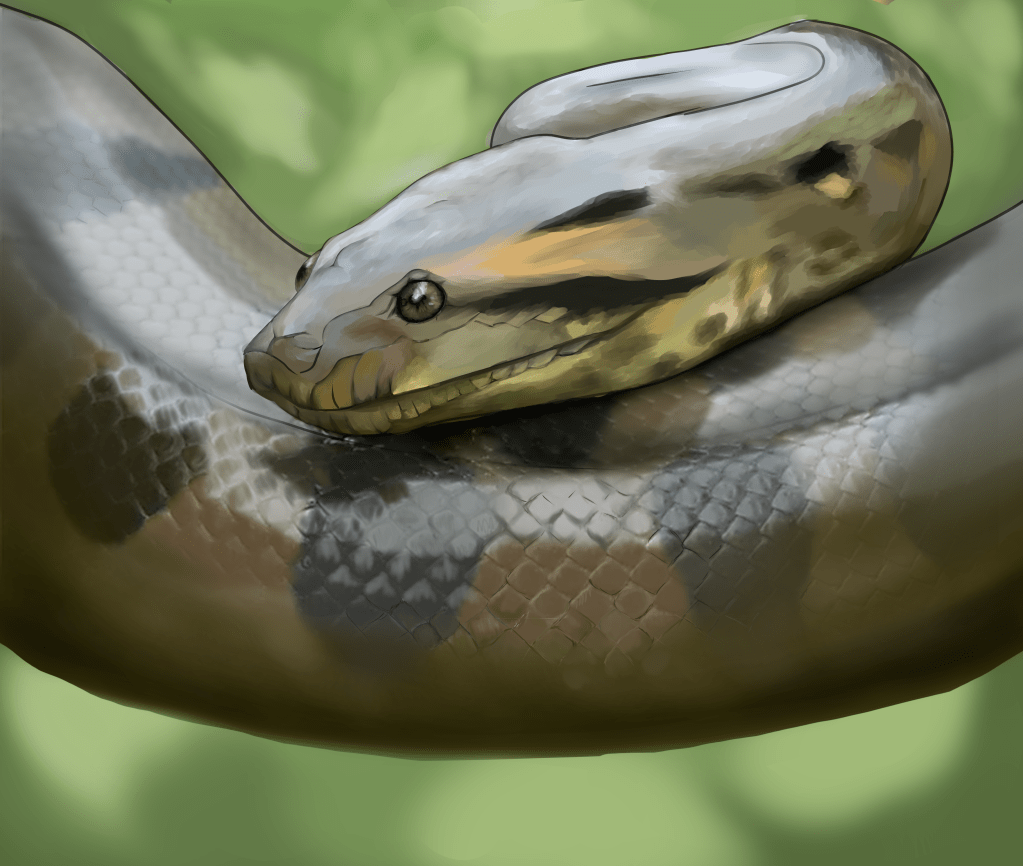
You’re skull may not be as malleable as a python’s but you will require a lot of flexibility. Don’t rush your dinner. you’ve put a lot of effort into it, by all means, enjoy it. Relish it. Remember to breathe, you can extend the top of your windpipe past any obstructions, anything from a Muscovy Duck (Cairina Moschata) to a White-tailed deer (Odocoileus virginianus) or a Capybara (Hydrochoerus hydrochaeris). Chewing is overrated though, so positioning is key. You want a dining experience that is as close to sausage shape as possible, you may have to manover your meal; Dig a little here, use a log as a prop there, but starting at the narrow head end is usually best. Incidentally, this is why you’ll likely be disinclined to eat a human despite being very capable of doing so, their shoulders are just too weird to be easily engulfed. Don’t get me started with the clothes, which brings me to your digestive system.
Digestion
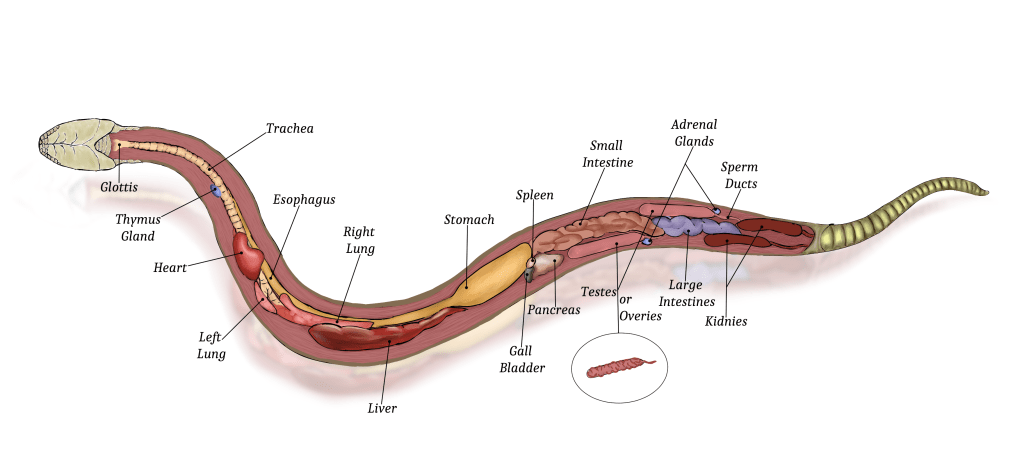
We start in an unlikely place. The skin. Snake skin needs to be stretchy, in the case of Anaconda the scales overlap to a certain degree, allowing for the skin and connective scales to expand for their meal. As for your organs; everything is long and everything in pairs is staggered to fit into a long thin tube, allowing organs to shift when the stomach and gut expand without crushing any other organs. Your lungs are also de-vascularised at the back for the same reason. The long structure means that air travels through parts of the lungs, allowing you to breathe while your organs are being crushed at the front and then the back, as large prey items are swallowed. You’ll have a large gall bladder to deal with fatty food, like the well-fed mammals on your menu, and of course, very strong stomach acid that dissolves hair, teeth, tissue, even the largest, densest bones.
If you have the luxury to return to a mammalian diet routine you will have to change this physiological marvel because regular meals are not what you’ve evolved for. Eating like a mammal will turn you into a big ol’ sausage and cause problems. Which brings us to what makes it so much cheaper to live as an anaconda.
Starvation mode
Like all carnivores, snakes have a short gut, unlike other carnivores they can deactivate their digestive system, by lowering oxygen levels in the gut and preventing digestive enzyme production. This is a method that mammals simply aren’t physiologically able to withstand to the same degree as our serpentine mentors. They follow two strategies supply and demand; the demand-side strategies are those that involve changes in metabolic rates to reduce how much energy the snake needs to fuel its body. The supply-side strategies involve physiological ‘decisions’ to mobilize and oxidize metabolic fuels. Fancy talk for saying some snakes can prioritize digesting and distributing the protein from their food to their cells and storing the Lipids. Conversely, when using their stores they will use Lipids (fats, if you’re normal) so they can preserve protein, (which is usually stored as muscle). You already use this strategy. You clever little monkey.
Weight loss stays consistent at 0.11% for the first 6 months, but as your body enters starvation mode the water content of your tissue will increase by about 5%, an increase similar to that of other vertebrates, possibly due to the breakdown of lipids or the reduction of tissue in nearly all your organs. The liver and heart mass reduces massively, permitted by the exceptional ability to reduce your metabolic rates during starvation, pythons can even rebuild cardiac tissues immediately after feeding, something that humans cannot do and often will develop cardiovascular issues when chronically malnourished. Large adult anacondas can tolerate more than 2 years of starvation provided they were in good condition beforehand. Tolerate isn’t thriving though, so even as your snaky self, such a long time without food is ill-advised. Especially if you’re a young noodly male.
Let’s get technical and talk Carbohydrate Dynamics. A sentence that strikes fear into the heart of biology students, including me. Your new snake form has ketone bodies like b-hydroxybutyrate; carbohydrates that are produced as a by-product of catabolism, (breaking down complex molecules of the organism’s own tissue) we can use those to measure how long a snake has been fasting. The ability to slow your metabolic demands means catabolism remains relatively low. It also impacts Lipid Dynamics. Snakes mobilize and subsequently oxidize endogenous lipids (internal fat stores) during starvation, reducing their fat content from 27.0% of their dry body mass to 14.7%. These fatty acids are not used indiscriminately, taken from their parent glycerol groups at different rates. Your body can now choose which fats to break down first. Protein Dynamics are a lot simpler, unlike fatty acids, amino acids are not differentially oxidized during starvation. When proteins are degraded into the constituent amino acids the mobilized monomers are ultimately oxidized because snakes do not have a mechanism to sequester specific amino acids. It’s less destructive to catabolise select lipids first, the goal is to not ruin your body. So long as you end your fast with a big meal like a capybara or a deer your serpentine physiology will take care of you. You can trust it.
If you read this far I’m guessing you aren’t in abject panic over your bills and wondering how to put food on the table tonight, but to those of you who are students and the worry is never far away I hope this provided a chuckle or two for your day, turning into an anaconda is probably about as useful as anything the UK government has suggested. Have a nice day, my dears, and have a great life.
For the curious
Calderón, M., Ortega, A., Scott, N., Cacciali, P., Nogueira, C. de C., Gagliardi, G., Catenazzi, A., Cisneros-Heredia, D.F., Hoogmoed, M.S., Schargel, W., Rivas, G. & Murphy, J. 2021. Eunectes murinus. The IUCN Red List of Threatened Species 2021: e.T44580041A44580052. https://dx.doi.org/10.2305/IUCN.UK.2021-2.RLTS.T44580041A44580052.en.

O’Shea, M., 2020. The book of snakes: a life-size guide to six hundred species from around the world. University of Chicago Press.

McCue, M.D, Lillywhite, H.B. and Beaupre, S.J (2012). Physiological responses to starvation in snakes: low energy specialists. Comparative physiology of fasting, starvation, and food limitation, pp.103-131.

Shibata H, Sakata S, Hirano Y, Nitasaka E, Sakabe A (2017) Facultative parthenogenesis validated by DNA analyses in the green anaconda (Eunectes murinus). PLoS ONE 12(12): e0189654. https://doi.org/10.1371/journal.pone.0189654

Thomas, O. and Allain, S. (2021). Review of prey taken by anacondas (Squamata, Boidae: Eunectes). Reptiles & Amphibians, 28(2), pp.329-334.

I came up with this title years ago when I was a broke student, this being part of a little series I’m working on to add some levity to the student experience, but I live in the UK where the cost of living crisis is a near constant worry. So here is a list of stuff from someone way smarter than I am whose goal is to actually deal with reality and not light-hearted hypotheticals.

www.moneysavingexpert.com/family/cost-of-living-kit/

I hope this article gave you a chuckle and I hope this website gives you some ideas. Good luck my lovely reader, have a manageable day and have a great life.
 Wonderfully Weird
Leave a comment