
Brought to you by the amphibian family who have stayed young for so long even taxonomists question whether they are salamanders. From god of fire, lightning and death to medical marvel, found in the deepwater channels and lakes of a tiny area in central Mexico. These amazing Ambystomatidae have their secrets, and now I shall share some of them with you.

Swimming Form
Don’t worry, those three awful swimming lessons you had when you were six will suffice. First off, you need to rid yourself of all this primate nonsense you’ve got going on. Opposable thumbs, endothermic capabilities, hair, that’s all useless to you now. Replace your four chambered heart with a three-chambered one and rip out those bronchiole filled lungs and go minimalist. Blood vessels, simple alveolar folds and smooth muscle tissues that can now facilitate gas exchange. Simple, think folded language rather than penne. Get a single circulatory system fitted.
Remove all hair follicles. All. Of. Them. The external gills are your hair now. The remarkable pair of rami lined by fabulous little fimbriae make a good substitute. The label feathery gills has been thrown about. Keep those filaments volumised and conditioned, the larger the surface area the more oxygen can be absorbed.
Now, about your skin. You waxed your body for a reason, apart from the amphibious quality regarding the lack of hair follicles, to help you fit in there is also the curiosity of cutaneous respiration. Like any child, you are thin skinned. Metaphorically or otherwise, this means oxygen can pass through your skin and into your bloodstream, as can poisons, pollutants and petulant comments. Breathing through your skin is a risky business but so long as your environment isn’t filled with those and you keep your skin hydrated you’ll be just fine.
If all this makes you nervous, maybe it’s getting hard to breathe? Take a deep breath in… and….that’s it. The buccopharyngeal membrane at the back of your throat is permeable to oxygen. Allowing you to take quick gulps of air when life gets stressful and oxygen runs low.
Stay away from iodine. A small amount will break the enchantment and trigger metamorphosis. Any more than 2ppm (parts per 1 litre of water) and you’ll die. Any Iodine contaminated with alcohol like most available in shops and you’ll die. You’re underage forever, no drinking. If this makes you feel a little down, gulping air bubbles will raise you right up.
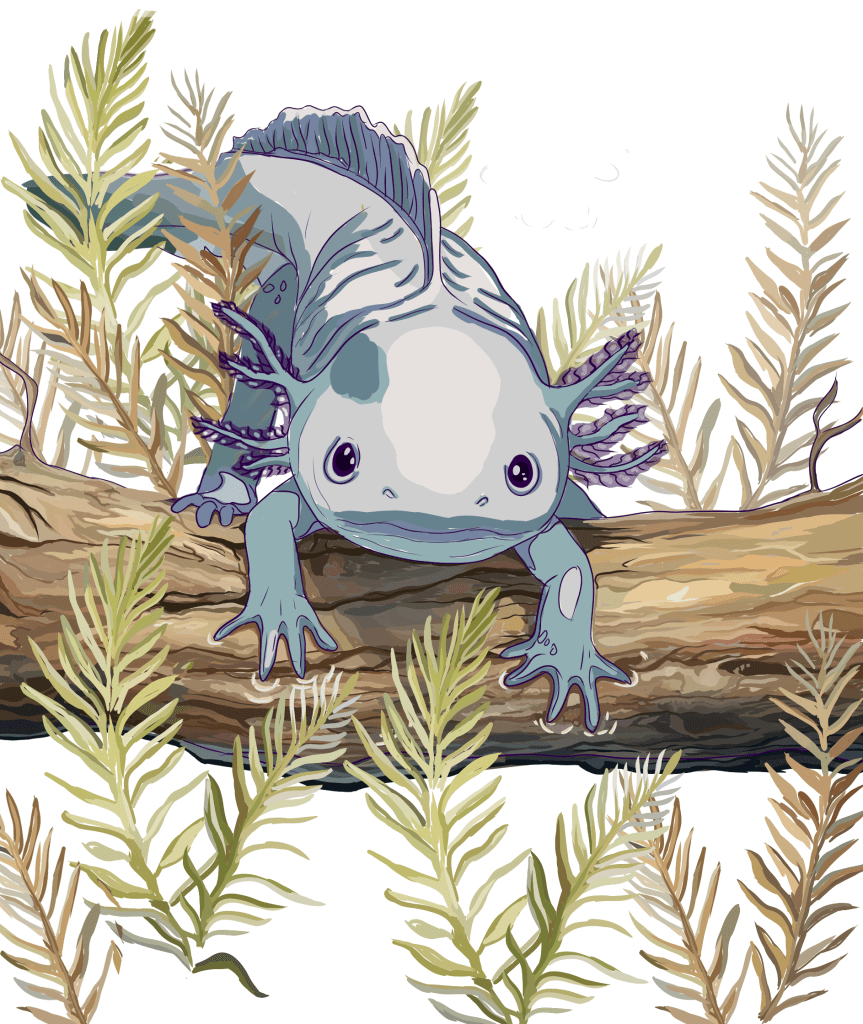
Younger looking skin and a withered old soul
Neoteny will ensure you look young, but not stay young unfortunately you will of course die, but just because you act like a child this doesn’t mean you can’t grow a little wiser and a little better every day. So, how do we freeze time for you young Peter Pan? Deny and suppress everything. Pretend that your hypothalamus is an island unphased by corticotrophin-releasing hormones. Your pituitary is a picture of solitude, ignoring the disruptive thyroid-stimulating hormones. These hormones will rise up like repressed childhood memories and force you into developing adult things like fully-functioning lungs, debt, insomnia and steal your crown of gills away, so keep thyroid hormones at a low level. Don’t tell anyone why.
Scares and missing limbs are for old people. Do you see young people on TV with horrendous injuries living happily? No. So they can’t possibly exist. Rather than taking the mammal route and only allowing full regeneration while remaining a foetus, with permanently hypoxic cells and a sterile womb environment that allows you to safely maintain an immature immune system that doesn’t know when to stop, your little axolotl self can ignore what humans do and aim for complete cellular regrowth while still living your free independent life. It’s all about the matrix. The suppression of homeostasis at the right time and the production of enzymes so the body has time to form new glands and dermal layers rather than being quick and sloppy like mammalian healing. This balancing of the extracellular matrix and metalloproteinases matrix is what will give you that flawless healing, limb regrowing and forever younger-looking skin.
Swim Free
And now Peter Pan you shall never look old. You shall not carry scars or missing limbs. You could cross a million rivers or live long in a lab, baffling and intriguing scientist, questioning how many species belong under the axolotl taxonomical umbrella.
A word of warning, this won’t solve the whole death business and let me tell you young axolotl, “It’s a terrible thing to be nearly sixteen and the wrong species.” If you grow tired of people talking to you like the child you present as. then get a prescription of 50 nanometres of T4 (Thyroxine). This dose of thyroid hormone will activate the genes required for you to finally grow up. Age with dignity and grace and in your own time.
Until next time wonderful reader. Have a nice day and have a great life.
For the curious
Crowner, A., Khatri, S., Blichmann, D., & Voss, S. R. (2019). Rediscovering the Axolotl as a Model for Thyroid Hormone Dependent Development. Frontiers in endocrinology, 10, 237. doi:10.3389/fendo.2019.00237

Demircan, T., İlhan, A., Aytürk, N., Yıldırım, B., Öztürk, G. and Keskin, İ. (2016). A histological atlas of the tissues and organs of neotenic and metamorphosed axolotl. Acta Histochemica, 118(7), pp.746-759.

Luis Zambrano, Paola Mosig Reidl, Jeanne McKay, Richard Griffiths, Brad Shaffer, Oscar Flores-Villela, Gabriela Parra-Olea, David Wake 2010. Ambystoma mexicanum. The IUCN Red List of Threatened Species 2010:e.T1095A3229615. doi./10.2305/IUCN.UK.2010-2.RLTS.T1095A3229615.en

Monaghan, J. R., Stier, A. C., Michonneau, F., Smith, M. D., Pasch, B., Maden, M., & Seifert, A. W. (2014). Experimentally induced metamorphosis in axolotls reduces regenerative rate and fidelity. Regeneration (Oxford, England), 1(1), 2–14. doi:10.1002/reg2.8

Saito, N., Nishimura, K., Makanae, A. and Satoh, A., 2019. Fgf-and Bmp-signaling regulate gill regeneration in Ambystoma mexicanum. Developmental biology, 452(2), pp.104-113.

Seifert, A.W., Monaghan, J.R., Voss, S.R. and Maden, M., 2012. Skin regeneration in adult axolotls: a blueprint for scar-free healing in vertebrates. PloS one, 7(4), p.e32875. doi.org/10.1371/journal.pone.0032875
 Wonderfully Weird