
From the Neritic Zone of the Atlantic to Asiatic mangroves, these amazing Arthropoda have spent 450 million years almost entirely unchanged. Why mess this perfection? The kind of perfection that may assist a Mammalia in need of a survival guide to a plague-ish predicament. These are not just some common Merostomata. Welcome, to the ancient and most noble Limulidae family. Who’s blue blood runs back 20 million years. This order of Xiphosura has an ancient yet effective immune system. Why not learn from the best?
Can anybody find me some other body?
An immune system only works if you’re alive enough to use it. Use those new nine eyes of yours. Dispense with the whole skin thing as well, a barrier is important but skin is a new development of evolution and really finicky. If you want to be in the Limulidae family, exoskeletons are essential. There are four schematics to choose from; The metal looking tri-spine (Tachypleus tridentatus) of the south china sea coast. A perfect anti hug device. The Atlantic horseshoe crab (Limulus polyphemus), the largest and probably the first to appear in a google search. Typical American species. If you aren’t keen on blood donation, prefer quieter beaches, and a smaller body plan, I’d recommend Indo-Pacific (Tachypleus gigas) or Asiatic mangrove horseshoe crabs (Carcinoscorpius rotundicauda).They’re a little more of a mystery, but all have the same circulatory, respiratory and immune systems.
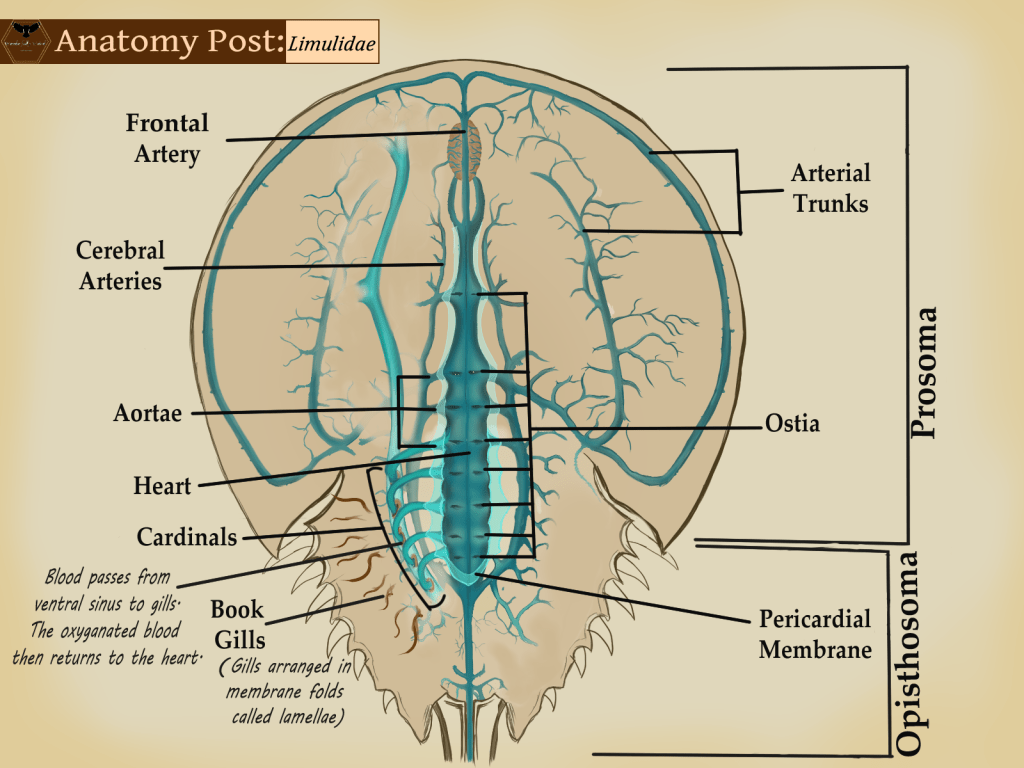
When I say “circulatory system,” I don’t mean all this, “closed system with lungs, hundreds of veins and capillaries,” and all that nonsense. No no no, simplicity is key with Horseshoe Crabs. Have an open circulatory system installed, you’ll still have a heart, and gills that act as lungs, even allowing you to breathe above water, as long as they’re damp, you’ll just be removing unnecessary piping like capillaries. I suppose you could get away with just changing your blood, but we don’t do half measures here. Copper blood also doesn’t transfer as much oxygen, which sapien bodies have a tendency to need a lot of. Think of putting petrol into a diesel, it wouldn’t work out well for you.
Blood
As a lovely Limulidae, there will be some differences at a haematological level. Blood my dears. As a homo sapien, you’ve been used to haemoglobin (Hgb), an iron-containing metalloprotein that binds to blood cells (Eurythrocytes) and carries oxygen around the body. Being bound to a cell allows for more control over the direction of oxygen and transport through the body and its many many membranes. As a Merostomata you’ll become acquainted with haemocyanin (KLH), another metalloprotein, but a copper-containing one. It gives the blood its signature blue colouration but doesn’t bind to a Eurythrocyte, instead it remains free-floating within the haemolymph.
Blue blood is a plus, but that isn’t why you’ve gone through all these changes. Let’s discuss your immune system, lest you start having trouble in dealing with these changes. You’ll keep the first line of defence against pathogens, but instead of skin you’ll have the magnificent amour of an exoskeleton. This isn’t as flexible as skin, so your yoga days are done. If you had no yoga days, then this is the perfect excuse never to develop any.
This immune system is perfect, especially if you’re lazy. An innate immune response happens automatically, unlike the active immune system you has as a land monkey, where your body developed a tailor-made torment in the form of an antibody, in response to bacterial pathogens. This allows for helpful bacteria within organ systems like the gut, but honestly, it’s so much effort, and sometimes you’re body can’t fight the infection in time. So innate immune system it is! Granular amebocytes (a kind of haemocyte) are the primary defence within the haemolymph. Granular amebocytes detect endotoxins (lipopolysaccharide), more specifically the (1,3)ß-D glycan, present in the cell walls of certain Gram-Negative Bacteria and Fungi. This triggers an enzyme cascade. Causing amebocytes to clot around the pathogen, inhibit its growth and break it down.
Now you know antibodies are out of the question. If you’re still attached to your gut bacteria, look for another animal class. The innate system cannot always tell the difference between friendly and fiendish bacteria. If you want to know how that feels, talk to a fellow sapiens who has an immune response disorder that leads to the body attacking itself. I’ve heard it’s not a great time, 0/10 would not recommend.
Vampiric Shore Monkeys
They wait at the shore for you to come spawning.
They’ll take you away and collect your blood at dawning.
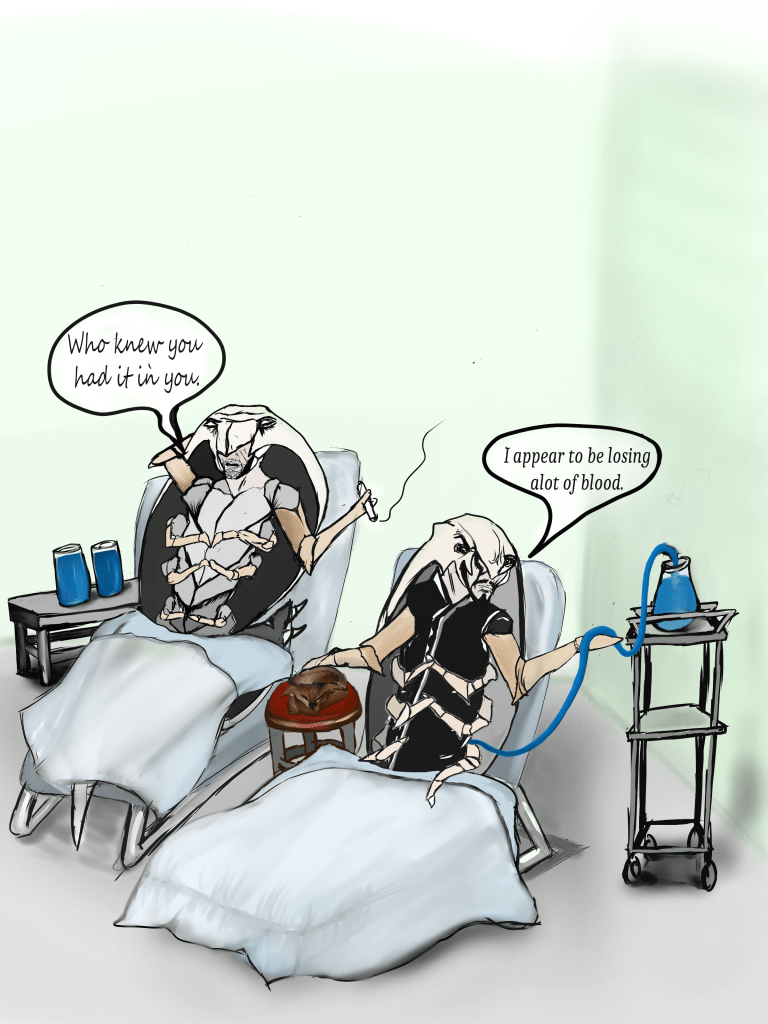
Jokes on them, you don’t have blood. Haemolymph is for an older class of beast, but that’s no fun. So… the innate reaction of your “blood” to endotoxins is extremely valuable to the bipedal shore monkeys. They harvest 30 to 40% from you, then releasing you back into the sea… or sell you for bait. It depends.
Assuming you aren’t under stressful transport conditions with 23°C water, stacked with other Limulidae, having 30% of your blood harvested and you’re a male, and not with a lab that sells you for bait, your chances of surviving are pretty good. With a 2.6% mortality rate, although these conditions are hard to come by. You’re more likely to fall around the 15% mortality mark. Be careful which donation clinic you attend. The two main donor species are Atlantic and tri-spine, so pick another species if you fancy your chances with habitat distinction rather than exsanguination.
Being under stress can affect your blood; Amebocyte concentration decreases and changes morphology. Haemocyanin concentration can also decrease, meaning you’ll become hypoxic and very few people enjoy that. The amebocytes are what the monkeys need to make Limulus amebocyte lysate (LAL). It’s used to test whether bacteria, living or dead, are present in foods, water, and pharmaceuticals, like vaccinations, which they’ve been needing a lot of recently. Try and get affiliated with a lab that has your best interests in mind, the vampire monkeys may not care about the quality of your blood, but you should. We all know what happens when blood donation sources aren’t taken seriously.
However, change is afoot. In a few years there may be less danger. New protocols regarding your annual donation. (Practice the process as a human first, it may help with the stress levels) there is also the 2018 synthetic alternative, rFC (recombinant Factor C), that could replace LAL, relieving pressure on you and your fellow Limulidae.
SO. Thank the crabs.
Thank you, dear reader. Have a nice day, have a great life and don’t come down with the sickness.
For The Curious
Bang, FB (1953) The toxic effect of a marine bacterium on Limulus and the formation of blood clots. Biol Bull 105:447-448.

Bolden, J., Knutsen, C., Levin, J., Milne, C., Morris, T., Mozier, N., Spreitzer, I. and von Wintzingerode, F., 2020. Currently available recombinant alternatives to horseshoe crab blood lysates: Are they comparable for the detection of environmental bacterial endotoxins? A review. PDA Journal of Pharmaceutical Science and Technology, 74(5), pp.602-611.

Göpel, T. and Wirkner, C. (2015) "An “ancient” complexity? Evolutionary morphology of the circulatory system in Xiphosura", Zoology, 118(4), pp. 221-238. doi: 10.1016/j.zool.2014.12.004.

- 1st paper about blood properties
Howell, W.H., (1885). Observations upon the chemical composition and coagulation of the blood of Limulus polyphemus, Callinectes hastatus, and Cucumaria sp. Johns Hopkins University Circular, 43, pp.4-5.

Kawabata, S., Koshiba, T. and Shibata, T., (2009). The lipopolysaccharide-activated innate immune response network of the horseshoe crab. Invertebrate Survival Journal, 6(1), pp.59-77.

Krisfalusi-Gannon, J., Ali, W., Dellinger, K., Robertson, L., Brady, T.E., Goddard, M.K., Tinker-Kulberg, R., Kepley, C.L. and Dellinger, A.L., (2018). The role of horseshoe crabs in the biomedical industry and recent trends impacting species sustainability. Frontiers in Marine Science, 5, p.185.doi.org/10.3389/fmars.2018.00185

Levin, J. Bang, FB (1968) Clottable protein in Limulus: Its localization and kinetics of its coagulation by endotoxin. Thromb Diathes Haemorrh (Stuttg) 19:186.

Luo, Z. et al. (2020) "Research Development on Horseshoe Crab: A 30-Year Bibliometric Analysis", Frontiers in Marine Science, 7. doi: 10.3389/fmars.2020.00041.

- 1st paper for synthetic blood
Maloney, T., Phelan, R. and Simmons, N., 2018. Saving the horseshoe crab: A synthetic alternative to horseshoe crab blood for endotoxin detection. PLoS biology, 16(10), p.e2006607. doi.org/10.1371/journal.pbio.2006607
 Wonderfully Weird
Leave a comment