

Gnathostomata. You both have backbones and mandibles what more could you possibly need in common? Allow me to introduce these classical Chondrichthyes and ostentatious Osteichthyes; their taxonomy, their aesthetics, where they live, and of course how long they are. The basics of any dating app. I’ll also present how they flirt and fu… mate and for those who want the stereotypical 1.7 children with the love of your life, you’re 42% likely to get divorced from, there is fecundity; The physiological potential of your chosen fish reproducing. Most don’t expect a long-term relationship or are content with polygamy. That whole three-second memory thing isn’t true and is just used as an excuse for inconsiderate behaviour. They have a penchant for topless beach shots, so if that’s a red flag to you maybe fish aren’t what you’re looking for. Do not fear me, you loathsome lazy creatures. Let’s observe these laws of nature at the seven seas of Rye and find you somebody to love.
Blackspot Tuskfish
(Choerodon schoenleinii)
Oder: Perciformes
Family: Labridae
Length: 1 Meter
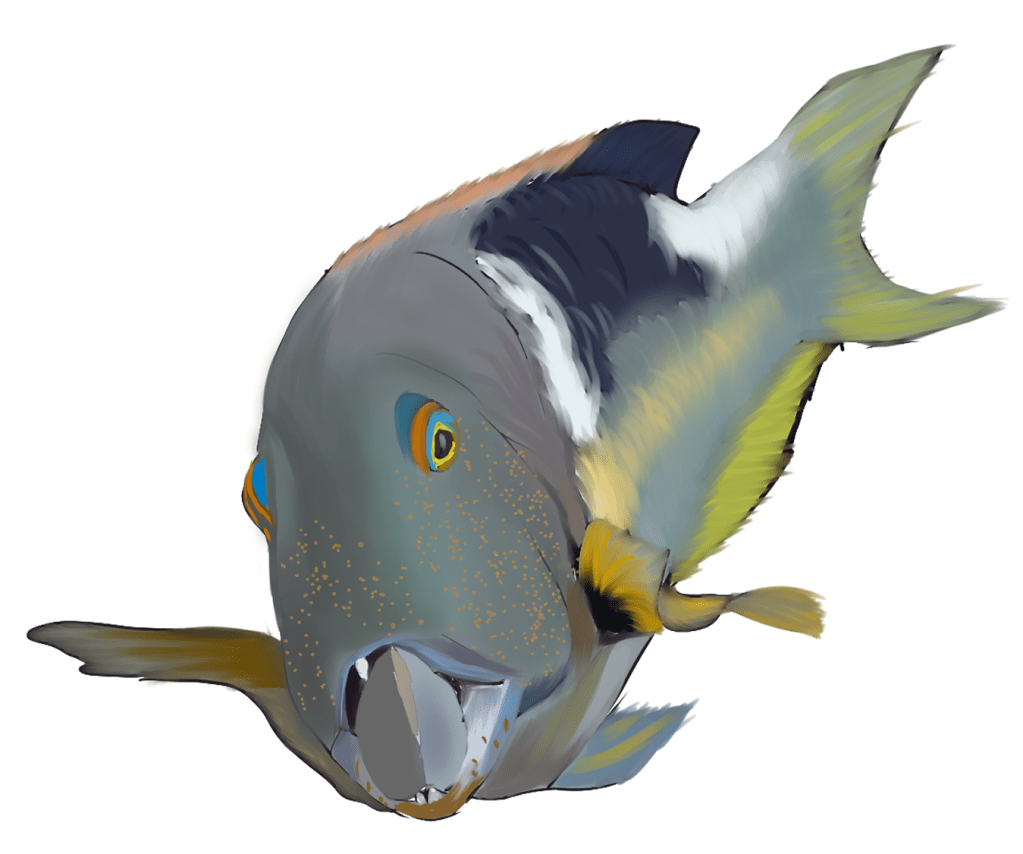
Males are bigger than females, something you’ve likely encountered as a mammal. Their aesthetics are largely the same, both like a vibrant colour palette to their cycloid scales. Befitting of the stereotypical bright colours of reefs, the cities of the seas. They’re handy with a tool, as long it’s orally operated, since these flamboyant fishes don’t have opposable thumbs they operate the commonly used anvils by other means to crack open clams and such. Both sexes prefer to dine in with a home-cooked meal. They’re largely the independent sort, meaning no matter who holds your interest you’ll have a partner who’s a good cook, but may not cook for you.
If you’re looking for a little romance with tropical sunshine and colourful reefs, these lovely Labridae would make a perfect holiday acquaintance. I advise double-checking to make sure the colours are still there, unless you vibe with that ghostly dead reef look. If you follow Tuskfish fashion trends you’ll at the very least stand out in the bleached-out underwater city.
Don’t expect them to commit to a single identity or one relationship. Tuskfish along with 1.5% of teleosts Actinopterygii infraclass display sex change adaptions. Living in reefs leads to a lot of labile adaptions, optimising reproductive success in fluctuating environments. They cope well with change, so even if you don’t someone in you’re temporary haremic group will. All tuskfish under 40cm are female they’ll change sex from female to male reaching 50 to 64 cm. It’s entirely normal and an excellent evolutionary adaptation.
Hermaphroditism mostly manifests in two modes Simultaneous and sequential; which can be protandrous (male to female), or protogynous (female to male) the most common among fish and the one displayed in tuskfish. The Size Average Modal (SAM) theory explains this adaption as sex change is timed to maximize higher reproductive success, male tuskfish hold a monopoly over females (haremic polygyny) so when fish reach a certain size and maturity it increases their reproductive success for the largest female to undergo protogyny if no decent males are swimming about. The SAM theory only works for sequentially hermaphroditic species, which lucky for me Tuskfish are. As per usual the bis are upsetting the binary and neat little modals again, as the often forgotten and unexplainable bidirectional hermaphroditism isn’t explained by the size-average-modal.
If you’re a male homo sapien and want to remain male as a tuskfish simply do what is natural. 17β – estrogen (E2) and 11- ketotestosterone (11 – KT) are the main estrogens and androgens respectively that shift during sex change. Elevate E2 followed by a steady increase of 11-KT running parallel with the proliferation of spermatogonia. Use The Hypothalamic – Pituitary – Gonadal (HPG) axis as the major signalling pathway. It’s easy. I could go into the Neuroendocrine molecular mechanisms that underlay all this behaviour, the neuropeptides and neurotransmitters like arginine vasotocin (AVT) and isotocin (IT) that modulate social behaviour across vertebrates, the correlation of differential expression of isotocin and social dominance in hermaphrodites and Gonadotropin-releasing hormones (GnRH) and their receptor expression fluctuations during protogynous sex change. Don’t even get me started on the Hypothalamic- Pituitary- Interrenal (HPI) axis being proposed to play a critical role in the regulation of sex change in protogynous hermaphrodites with cortisol (Cortisol also regulates stress responses, which is probably where you recognise it from). But honestly, it boils down to, when the feeling is right that’s when your partner or you will shift from female to male.
Gonadol reconstructing will happen all on its own because you’re a clever little fish. Basically, neurotransmitters will signal for the gonads to dramatically reconstruct the soft tissue. The previous ovaries having developed gonadotropin-dependent gametes producing vitellogenic oocytes and ovules, break down and degrade. New tissues ripen at a molecular level allowing the proliferation of spermatogonia from the new testis. Which now leaves you free to do what many fishes do best Spaaaaaaawn! So if you’re parental but asexual, Tuskfish are an excellent match and modal.
Would use Tinder and Grindr, they transition late and look fabulous, they don’t know any better and are going to be a dumb 20-year-old again.
European Sea Sturgeon
(Acipenser sturio)
order: Acipenseriforms
Family: Acipenserdae
Length: 3.5 Meters
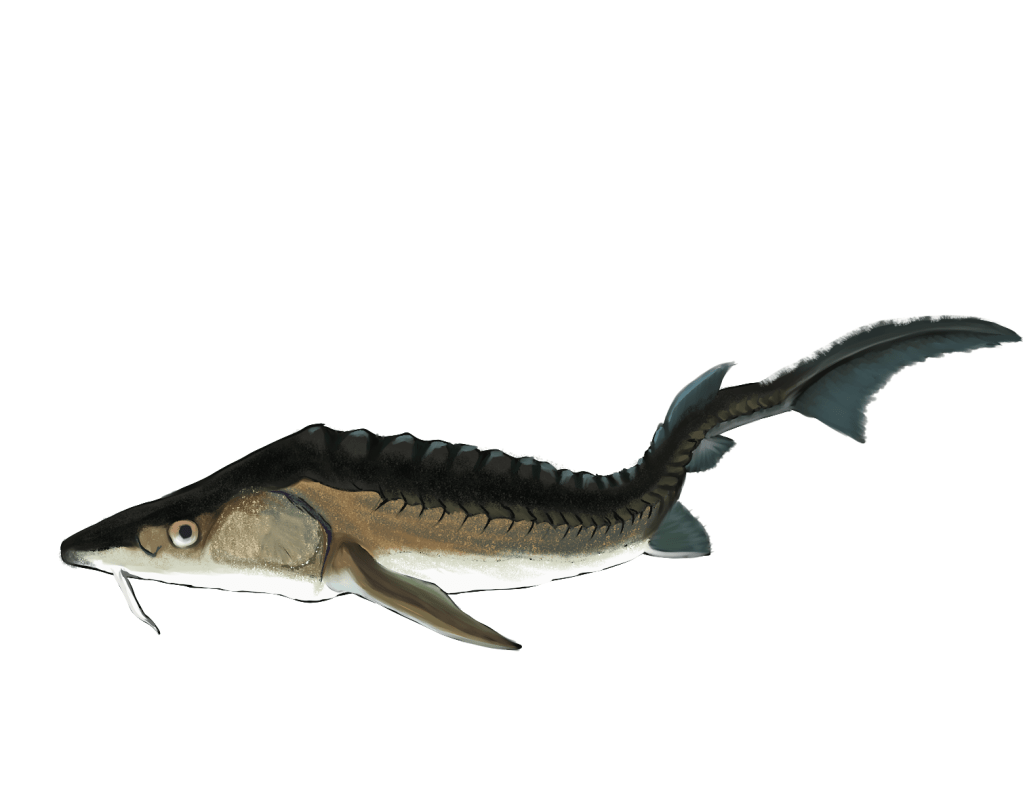
Their monochromatic Ganoid scales give a gothy vibe. they may not be colourful but they are striking and aren’t particularly interested in sexual dimorphism. Both sexes have moustache-like barbels, both have the grey scale look, and both would wear eyeliner if they were land monkies with laptops. Females are larger, so if you want to find a majestic gothy queen that won’t eat you, this is a good place to look, even for the landlocked, because these beautiful beasts are not married to the sea. They swim many temperate waters, or they used to. As a researcher of many fish you can find in the oceans, seas and rivers of the world I can tell you that under the forest or papers about overfishing and water pollution is some interesting ecology, and a fish with experience. These androgynous anadromous types migrate from oceans to freshwater lakes or streams as well as brackish waters. The few spawning rivers remaining are in France, so learn French as it’s clear the population isn’t going to be expanding anytime soon. The French call them Esturgeon by the way.
Molluscs and Crustaceans are the preferred dining option. Be warned, you’ll want a restaurant that gives experience dining. Sturgeons like to use their little moustache-like barbels to locate food. Sight isn’t their forte. They aren’t ones to travel far, staying around the coasts and rivers of Europe, nowhere too cold, nowhere tropical. Along with the anadromous river-to-sea travel is the obvious warning that the love of your life may get eaten by a bigger fish… or a trawler. Under the anthropomorphism of a creature that is far better at keeping a relationship murder free than our old acquaintance homo sapiens is a more casual, one-time-thing relationship that is free of all that unnecessary emotional baggage and physical intimacy. When you’re a sturgeon you can still have a sexy time without the sex. Males reproduce every other year, while females reproduce every 3 to 4 years (anything in-between is strictly recreational, although being a sturgeon there likely isn’t any) through spawning in stony rivers, non of this white sands and sunbathing nonsense, so if that’s your idea of a holiday find another fish, these guys are the wild swimming types.
Creative but with bad decision-makers, these guys would probably use OkCupid, they seem the type that would vibe with answering loads of questions so they can get away with the least amount of social interaction, being largely solitary in their everyday lives. Brilliant for bilinguals.
Whitepotted Eagle Rays
(Aetobatus narinari)
Order: Myliobatiformes
Family: Aetobatidae
Size: 5.5 Meters
Disk Width: 300 Centimetres
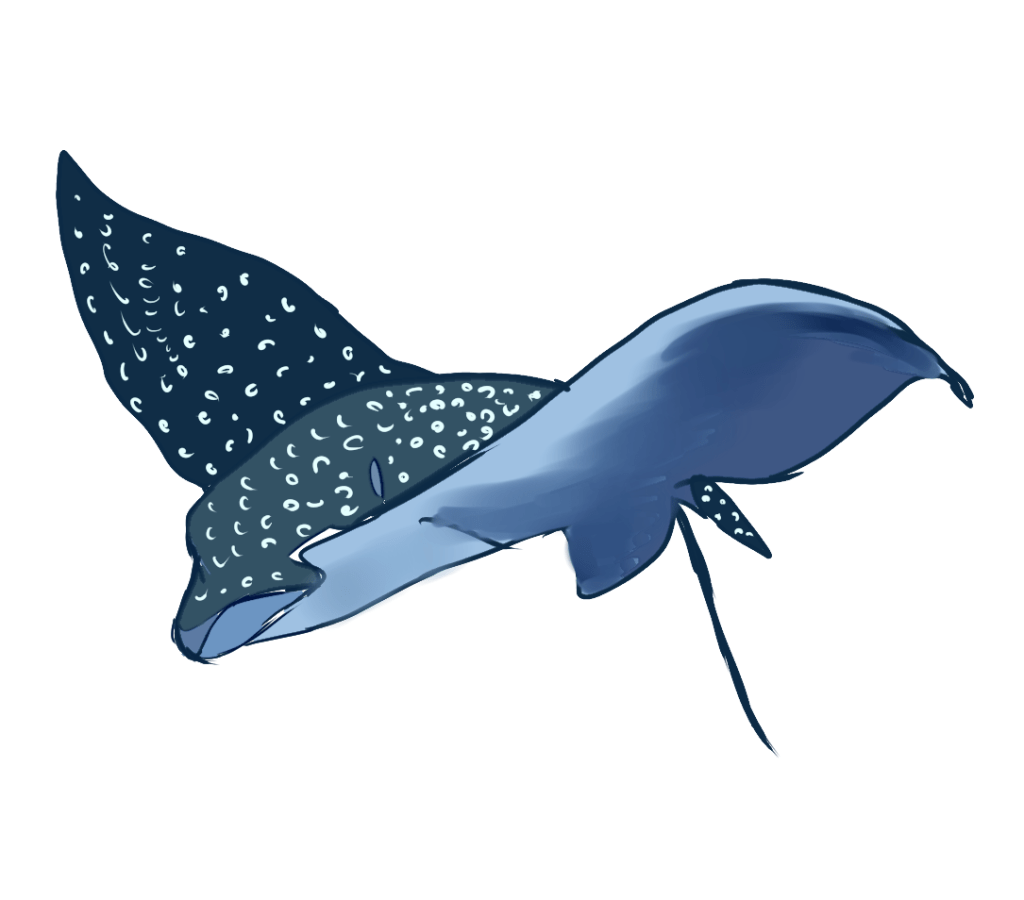
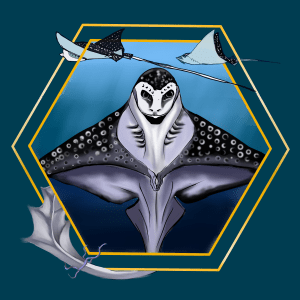
These marvellous Myliobatidae are mainly tail. It’s the chondrichthyan equivalent of high heels. They are a well-rounded ray, with larger females, but the average difference isn’t huge, even with the high-heel-equivalency. They also don’t bother with finicky scales, so even as a primate you at least have skin in common. Their less-is-more aesthetic sticks to a monochromatic palette and traditional countershading, being practical don’t mean you can’t be well-dressed. The perfect ray for those who like the eagle aesthetic but hate land and heights. Although, these guys like to dive up into the sky on occasion. An impressive sight, even if a relationship isn’t what you’re looking for.
Dinner plans can be tricky when you’re a wandering carpet with a mouth. Gastropods with a side of, Strombus pugilis, Americoliva reticularis, a Lobatus costatus here, maybe some Petrochirus diogenes there, are their preferences. These Neritic and Oceanic dishes are well suited for those who like to dine in warm mostly shallow waters. Some spotted rays wish for a more adventurous life in the Oceans, living in deeper semi-pelagic waters.
Wild mating behaviour has only been documented in 12 of the 600+ species of batoids due to the limited research, but the whole point of dating apps is to generalize as much as possible until you can convince the subject of your flirtations that you’re capable of normalcy, or you find a fellow fish in a birdcage. Batoids oh so love the chase. It’s an important part of their romantic script. Maybe a little rough as well, but nothing extravagant, non of this BDSM nonsense just your average biting and enthusiasm. The whole sequence takes around 60 minutes. Copulation itself only lasts ~30 seconds, so bear that in mind, Eagle Rays are not to be rushed, time must be taken with foreplay. They don’t rush in separating either, even without anything long-term. Short-term relationships are more their thing like with most Chondrichthyes. A. narinari doesn’t seem to have multiple male participation unlike other species, however, this may indicate of lack of observation. Other species seem to display it as the norm.
They can be a little barbed but ideal for a sweetly short and fun relationship with these beautifully and athletic whitespotted Aetobatidae. If you are hoping for children one day, internal fertilisation is pretty routine for Eagle rays. Around 4 pups develop ovoviviparously within Lady Ray. I.e. her eggs hatch within her and then the pups are released into the world. They’re listed as near threatened, so although they aren’t common by any means, you’ll be able to find one without having to commit to the city life.
These guys are playful and the females are the type to be proactive in luring in wandering males. They’re well-rounded and wholesome, these guys would use bumble.
Tiger Shark
(Galeocerdo cuvier)
Order: Carcharhiniformes
Family: Carcharhinidae
Length: 5.5 to 7.5 meters
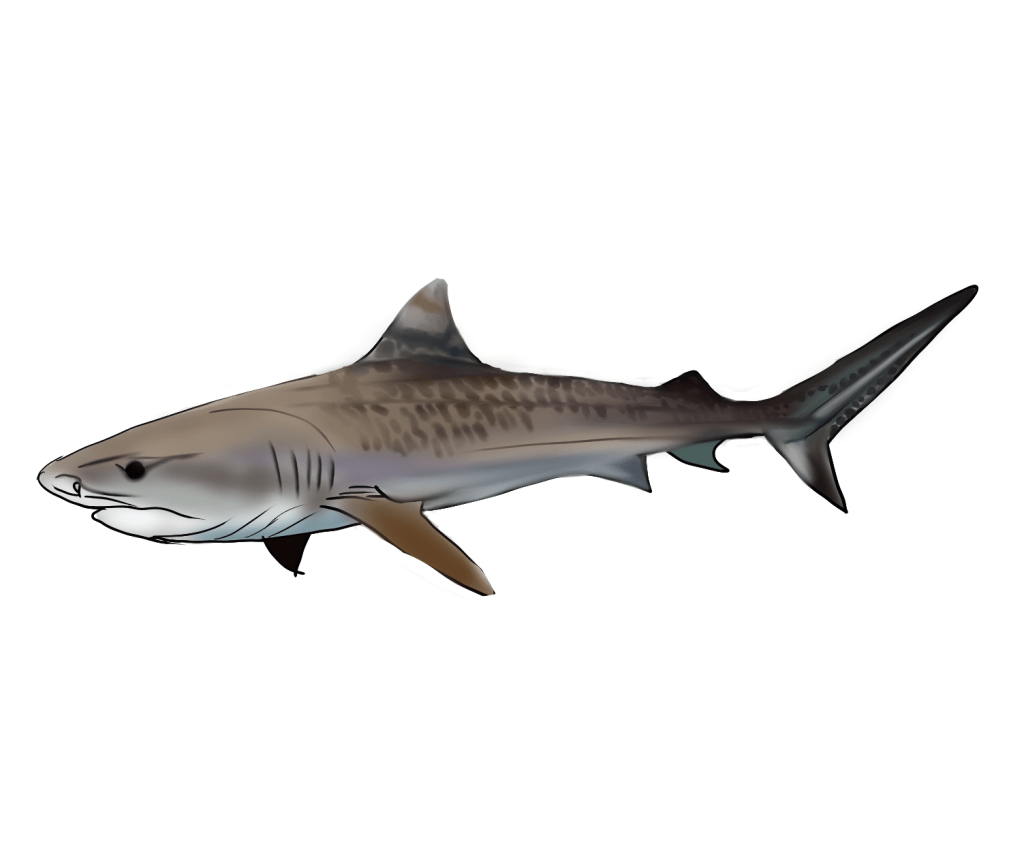
Another potential partner with skin and countershading, but let’s face it these guys have style. As is the way with many Carcharhinidae, the females are bigger. Bigger bodies, bigger apatites. Tiger Sharks are not fussy. Obligate carnivoroury isn’t the most complex of diets. Generalist predators have varied dining-out options as long as you have meat on the menu. If you’re veggie or vegan, maybe try another species… and class. Food preferences do shift depending on their trophic level so always consider your date’s ontogenetic dietary shifts and not just for their benefit. A word of warning for the young and naive. If the age difference is too large your date may eat you, and not in a fun way. Make sure you’re levels of maturity match up well, especially if you’re a male tiger shark, females are bigger than you, more aggressive and more likely to kill you, for a shark with a preference towards elasmobranchs and cetaceans you’ll be a snack in some form or another. Just something to bear in mind.
When not visiting home tiger sharks are found worldwide in warm waters, mainly pelagic with visits to insular reefs. You’re in for a fun hunting trip at the very least, in the mainly tropical, and subtropical waters. Maybe the occasional temperate trip but nothing below 17ºc. They like the Pacific and can be comfortable in shallower waters around the Pacific Islands if you’ve been hearing the ocean call to you, maybe this fanged and refined Carcharhinidae will be an ideal travel buddy for those who like chasing the warmer climate. The bigger and older the shark the deeper the water preference. From reefs of 10- 40 meters to deep sea ravines of 350m. Although who’s to say when no one really wants to study the details of their life?
They don’t drink, instead of swim bladders, they have very oily livers keeping them buoyant, which they have to look after. Absorbing water through their gills works for them because they have salt glands along their digestive system to aid osmoregulatory mechanisms, excreting the excess salt. You, little land monkey, would die. So ensure you make the appropriate lifestyle changes before you start dating. Tiger-sharks are into fitness in general, always on the move albeit at a gentle pace. The internal fertilisation aspect means they also like their intimacy. Intimacy takes many forms. In the tiger-shark world, it can draw blood. There tends to be a bit of biting involved, so although bondage is out of the question for a species with a ram ventilation respiratory system, a little light sadism is all part and parcel of Galeocerdo relationship scripts. Not every female exhibits bite scars and the location, freshness and patterns vary upon the individual but all were only present on sexually mature females, which honestly puts them one up from the land monkeys as a species.
It’s hard to collect data on mature individuates leading to the issue of poor documentation and analysis of population biology. They definitely aren’t prone to voyeurism. Although not above sentimentality. Females display philopatry, returning to their places of birth. Knowing which areas have the best pup-rearing policies after a long gestation period (12 to 16 months) of broods with 3 to 70 pups ~75cm long, you can see why you or your partner may want such assurances? Monogamy seems to be the norm, gravid (pregnant) females don’t show any genetic polyandry, meaning pups all shared the same biological parentage. Likely reflecting both long reproductive cycles and specific reproductive behaviour related to their solitary pelagic wandering nature. They also exhibit a unique reproductive mode among elasmobranchs, embyotrophy. Embryos are nourished first by yolk and later by energy-rich uterine fluid, otherwise known as Ovoviviparity or aplacental viviparity, it’s mentioned elsewhere in this list.
They’re not here to fuck around and find out in regards to what they like, they know their into kinks so they’d choose a kink-friendly dating app OkCupid with all the kink questions answered or Feeld, with Fetlife to keep in touch with the community. But let’s be honest, they’re an apex predator and high up on the charismatic scale, everyone knows the tiger shark, so Kinki is their site of choice. You pay for a sub.
Whale sharks
(Rhincodon typus)
Oder: Orectolobiformes
Family: Rhincodontidae
Length: 5.5 to 10 meters
There’s always one 12m individual who has bragging rights
but not much else. Maybe age and wisdom.
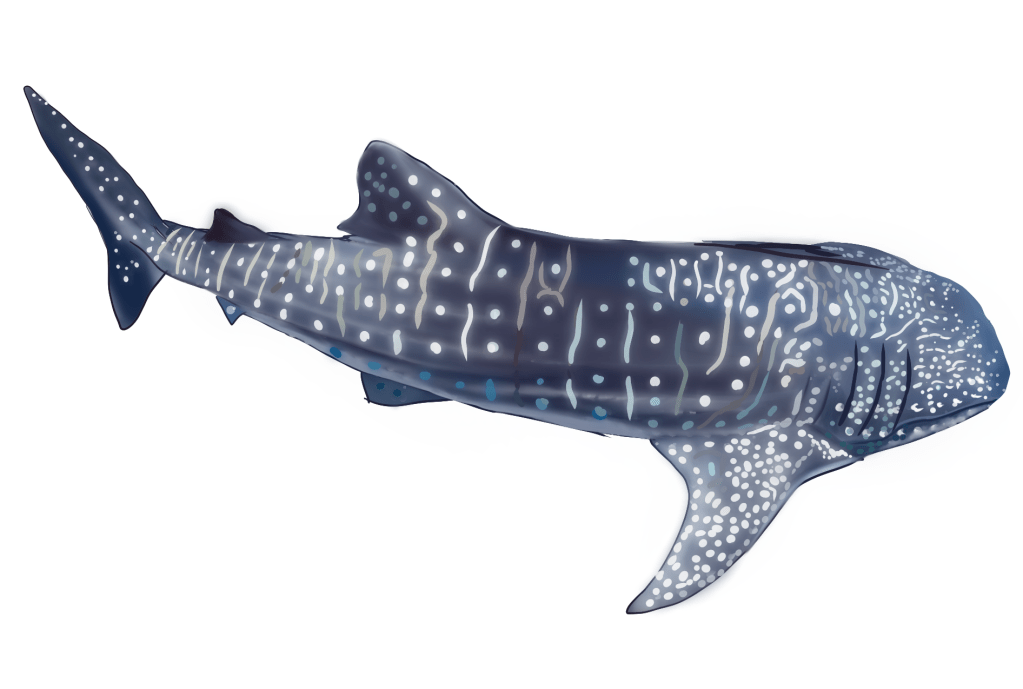
For those who like a partner with an air of mystery, there is the whale shark. Females are bigger, making them the biggest fish in these here oceans. Here there be monsters. Set aside your fears and get yourself the biggest, most charismatic baroness in the ocean. It worked for Ank Morpork’s Sam Vimes it’ll work for you. Just like Sybil Ramkin, these creatures are both majestic in their aesthetics and practical in their countershading, maintaining their enigmatic selves fading into the deepest depths and sparkling surfaces.
Food is a way of life for them, this filter feeder is a fan of seafood soup. krill, plankton, fish eggs, marine snow, anything small and free-floating. They’ll follow the circumtropical currents of oceans that carry their food. Neritic waters for the young and Oceanic for the old, a prime partner if you like to travel sedately around the globe but can’t afford to go on a cruise ship. They have been known to dive to 1,900 meters so the relationship is not without its pressures but having a steady partner who functions well under them can be a lifeline or at the very least nice to have. Whale sharks are well accustomed to such pressures having been born at depths of around 300 metres.
They are warmer at heart than smaller fish, you can call it love and affection, or you can call it higher interia thermal inertia and smaller surface-to-volume body ratio, but that’s up to you. Whale Sharks are also wonderful at picking up litter, even litter that isn’t their own… they may not be your partner for very long, and not just because Whale Sharks don’t seem to be monogamous. Monogamy isn’t always the end goal, If you want a short-term relationship without orgies then maybe the resplendent Rhincodon typus is the fish for you. Mating behaviour involved one individual swimming beneath another ventral side up, no biting, threesomes or other behaviours have been seen. They’re very private, chemical signalling is likely used to attract each other, so pick a nice perfume, it’s important to judging who the love of this season might be.
Whale sharks may be able to store sperm after mating, meaning they can wait for years between mating and fertilising their eggs. You’ll have full control if or when you become a parent to up to 300 pups. Once again you’ll be meeting the old strategy of Ovoviviparous or aplacental viviparity, you should be fairly well acquainted with it by this point, but if you still have questions and confusions regarding how baby whale sharks are made these are probably the best sharks to answer your questions given their relaxed nature. Though their brains indicate that intellectual conversation is not their forte, their highly foliated cerebellum takes up 28 to 32% of their brain. Their motion and coordination skills are excellent. Make of that what you will.
As for dating apps they’d use. Hinge. I will not elaborate.

What I’ve learned over the writing of this article is that most fish are too queer to comfortably fit in tinder, but that doesn’t stop them from signing up for it regardless. Until next time lovely reader. Have a nice day and have a great life.
For the Curious
Lubitz, N. et al. (2022) “The role of context in elucidating drivers of Animal Movement,” Ecology and Evolution, 12(7). Available at: https://doi.org/10.1002/ece3.9128.
Tusk fish
Akita, Y., Ebisawa, A., Hirai, N., Asami, K., Ohta, I., Uehara, M., Teruya, K., Yamada, H., Kobayashi, M., Sato, T. and Okuzawa, K., 2017. Difference in age, growth, and sexual demography of black‐spot tuskfish, Choerodon schoenleinii (Valenciennes, 1839), in two adjacent populations, Ryukyu Archipelago, southern Japan. Journal of Applied Ichthyology, 33(3), pp.437-442. doi.org/10.1111/jai.13270

Casas, L. and Saborido-Rey, F. (2021) “Environmental cues and mechanisms underpinning sex change in fish,” Sexual Development, 15(1-3), pp. 108–121. Available at: https://doi.org/10.1159/000515274.

Kuwamura, T. et al. (2020) “Hermaphroditism in fishes: An annotated list of species, phylogeny, and mating system,” Ichthyological Research, 67(3), pp. 341–360. Available at: https://doi.org/10.1007/s10228-020-00754-6.

Pryor, K.J. and Milton, A.M., 2019. Tool use by the graphic tuskfish Choerodon graphicus. Journal of fish biology, 95(2), pp.663-667. DOI: 10.1111/jfb.13983

Sato, T., Kobayashi, M., Takebe, T., Hirai, N., Okuzawa, K., Sawaguchi, S., Matsubara, T., Yamaguchi, T., Shinoda, R., Koiso, M. and Teruya, K., 2018. Induction of female‐to‐male sex change in a large protogynous fish, Choerodon schoenleinii. Marine Ecology, 39(1), p.e12484. doi.org/10.1111/maec.12484
Tiger shark
Dicken, M.L., Hussey, N.E., Christiansen, H.M., Smale, M.J., Nkabi, N., Cliff, G. and Wintner, S.P., 2017. Diet and trophic ecology of the tiger shark (Galeocerdo cuvier) from South African waters. PloS one, 12(6), p.e0177897. doi.org/10.1371/journal.pone.0177897

Holmes, B.J. et al. (2018) “Lack of multiple paternity in the Oceanodromous Tiger Shark (galeocerdo cuvier),” Royal Society Open Science, 5(1), p. 171385. Available at: https://doi.org/10.1098/rsos.171385.

Gerzeli, Giuseppe; de Stefano, Gian Franco; Bolognani, Lorenzo; Koenig, Kurt W.; Gervaso, Maria Victoria; and Omodeo-Salé, Maria Fausta, "The Rectal Gland in Relation to the Osmoregulatory Mechanisms of Marine and Freshwater Elasmobranchs" (1976). Investigations of the Ichthyofauna of Nicaraguan Lakes. 51

Simpfendorfer, C.A., Goodreid, A.B. & McAuley, R.B. Size, Sex And Geographic Variation in the Diet of the Tiger Shark, Galeocerdo Cuvier, From Western Australian Waters. Environmental Biology of Fishes 61, 37–46 (2001). https://doi.org/10.1023/A:1011021710183

Pirog, A., Magalon, H., Poirout, T., & Jaquemet, S. (2020).New insights into the reproductive biology of the tiger shark Galeocerdo cuvier and no detection of polyandry in Reunion Island, western Indian Ocean. Marine and Freshwater Research, 71(10), 1301. doi:10.1071/mf19244

Rangel, B.S., Afonso, A.S., Bettcher, V. et al. Evidence of mating scars in female tiger sharks (Galeocerdo cuvier) at the Fernando de Noronha Archipelago, Brazilian Equatorial Atlantic. Environ Biol Fish 106, 107–115 (2023). https://doi.org/10.1007/s10641-022-01380-z
whale shark
Tomita, T., Murakumo, K., Komoto, S., Dove, A., Kino, M., Miyamoto, K. and Toda, M., 2020. Armored eyes of the whale shark. Plos one, 15(6), p.e0235342. doi.org/10.1371/journal.pone.0235342

Thomson, J.A., Araujo, G., Labaja, J., McCoy, E., Murray, R. and Ponzo, A., 2017. Feeding the world's largest fish: highly variable whale shark residency patterns at a provisioning site in the Philippines. Royal Society open science, 4(9), p.170394. doi.org/10.1098/rsos.170394

Miranda, J.A. Yates N, Agustines A, Enolva N P., Labaja J, Legaspi C, McCoy E , Ponzo A , Snow S, Araujo G (2020) “Donsol: An important reproductive habitat for the world's largest fish rhincodon typus ?,” Journal of Fish Biology, 98(3), pp. 881–885. Available at: https://doi.org/10.1111/jfb.14610.

Weber, J.A., Park, S.G., Luria, V., Jeon, S., Kim, H.M., Jeon, Y., Bhak, Y., Jun, J.H., Kim, S.W., Hong, W.H. and Lee, S., 2020. The whale shark genome reveals how genomic and physiological properties scale with body size. Proceedings of the National Academy of Sciences, 117(34), pp.20662-20671. doi.org/10.1073/pnas.1922576117
Eagle rays
Cerutti-Pereyra, F., Bassos-Hull, K., Arvizu-Torres, X. et al. Observations of spotted eagle rays (Aetobatus narinari) in the Mexican Caribbean using photo-ID. Environ Biol Fish 101, 237–244 (2018). https://doi.org/10.1007/s10641-017-0694-y

McCallister, M., Mandelman, J., Bonfil, R. et al. First observation of mating behavior in three species of pelagic myliobatiform rays in the wild. Environ Biol Fish 103, 163–173 (2020). https://doi.org/10.1007/s10641-019-00943-x

Mendonça, S.A. et al. (2020) “Dancing with the devil: Courtship behaviour, mating evidences and population structure of the Mobula Tarapacana (Myliobatiformes: Mobulidae) in a remote archipelago in the equatorial Mid-Atlantic Ocean,” Neotropical Ichthyology, 18(3). Available at: https://doi.org/10.1590/1982-0224-2020-0008.
European sea sturgeon
Lohe, A., 2021. Adriatic Sturgeon (Acipenser naccarii), European sturgeon (Acipenser sturio), Chinese sturgeon (Acipenser sinensis), Sakhalin sturgeon (Acipenser mikadoi), Kaluga sturgeon (Huso dauricus) 5-Year Review: Summary and Evaluation 2021.
 Wonderfully Weird
Leave a comment